This is the last post on the Low Carb Wisdom blog. But I will be continuing my blogging at a new blog, Real Food Wisdom (more on the new blog below). I am abandoning this blog as I no longer consider myself to be following a low carb way of eating. I am grateful for the introduction to the low carb lifestyle, as it opened my previously closed eyes to the realities of eating nutrient dense foods. But I no longer believe the central, low carb article of faith: the Taubesian hypothesis that carbohydrates elevate insulin levels, which in turn drives fat storage. I also reject the belief that you must only count carbs, not calories and I reject the belief that exercise does not help with weight loss. These three ideas are elaborated on at length in Gary Taubes' book, Why We Get Fat.
This means I do believe there are good carbs (e.g., potatoes, white rice) and bad carbs (e.g., refined wheat or sugar), just as there are good proteins (e.g., meat) and bad proteins (e.g., gluten) and good fats (e.g., butter or lard) and bad fats (e.g., soybean or corn oil). I am also put off by all the low carb dogma out there, where you are a "sinner" if you eat a potato or white rice. Also, there is a growing recognition that the low carb way of eating is not a magic bullet, that low carb can cause problems (and abandoning low carb may actually cure those problems), and that some carbs may actually help with weight loss.
So what do I believe? How will I be eating in the future? I now consider myself to be following a version of the Paleo diet and briefly considered creating a blog called "Paleo Wisdom" (the name is available), but I didn't want to lock myself into another diet mode (repeating the "Low Carb" mistake by linking my way of eating to a specific, named dietary approach). The version of the Paleo diet that I follow most closely is the Jaminets' Perfect Health Diet, which is controversial in the Paleo community, because it doesn't shun potatoes, rice, and dairy. But I reserve the right to change my mind in the future about what I eat, as new evidence comes along.
So what do I believe? And how will it affect my future diet?
I believe that natural, real, whole foods are best, foods with very little or no processing. This means I am open to some non-Paleo belief systems, such as the Weston A. Price view of nutrition. It also means that things like potatoes and bananas are fine to eat, in moderation, and perhaps even correctly prepared, ancestral wheat.
I believe that eating animal products is essential to good health.
I believe that correctly rendered lard, butter, egg yolks, meat, coconut and olive oils, tree nuts and other high fat items are healthy for you and won't give you a heart attack. I am grateful to Good Calories, Bad Calories by Gary Taubes for opening my eyes on this point.
I believe that calories count, that this is the biggest determinant of weight loss and maintenance. I also believe that calorie restriction is necessary for maintaining appropriate blood glucose levels. It is not all about eliminating carbs, it is also about limiting calories. Adding in potatoes and rice, while watching calories, actually helped me stabilize my blood glucose levels.
I believe in eating vegetables. Lots of vegetables. And some fruit.
I now believe that food reward and palatability are crucial concepts to understand in losing and maintaining weight. I believe that simple foods are best, for most occasions. Thank you, Stephan Guyenet.
I believe in exercise. Both resistance training and cardio vascular. Just not to excess.
I believe that eating nutrient dense, whole, real foods is a high fat, moderate protein, and low carb approach to eating. Therefore, it is not necessary to add fat just to be more healthy. It is already high fat.
I believe in (this may surprise you) the Weight Watchers approach to losing weight. Not their low fat mantra nor their fat phobia, but their psychological perspective on weight loss, the weekly accountability of weighing in and the community support one gets from interacting with others on a similar weight loss journey. One of my most gratifying experiences in life was when I was a leader at Weight Watchers. I have written about this before and I am now actively considering re-joining Weight Watchers, but on my own terms. Calories count, but counting calories is a bummer. Counting points is easier. I can eat Paleo using their point system to track calories and I will lose weight. Plus I will gain the support of the people in the weekly meetings and perhaps influence some of their attitudes about eating real food.
So if you have enjoyed what I have written on Low Carb Wisdom, consider following me as I transition to Real Food Wisdom. The first post will be up shortly, probably tomorrow.
Showing posts with label Paleo. Show all posts
Showing posts with label Paleo. Show all posts
Saturday, March 17, 2012

Sunday, March 11, 2012
Dinner at the Paleo Restaurant Sauvage in Berlin
I was recently in Berlin, Germany, and had dinner at the Paleo restaurant, Sauvage (sauvage is French for "savage") and want to report on the experience.

First of all, the only lighting in the restaurant was candle light, so most of the following photos are blurry, as my not-so-smart-phone had trouble focusing on the dishes.

Also, this is upscale, fine dining. Berlin has some very inexpensive restaurants, but this one is for the foodies among you, and, consequently, has prices to match. I ordered a starter, main dish, dessert, and bottle of designer mineral water. I do not drink, so wine is not included in my total. I spent 45 euros on the meal, or approximately $60. But I am a foodie and it was so very worth it. The only thing missing from the experience was my wife, who is also a foodie, but who did not accompany me on this trip. The other professors on this study abroad trip had no interest in eating "caveman" food and I know them well enough to know they are not foodies. So I went alone. Melissa McEwan, you are not the only one who dines alone from time to time.
The restaurant is rather small and I doubt it could hold more than 35 to 40 patrons. It was minimally decorated, but that was fine because they only used candles for lighting and you couldn't really see a lot (though there were electric lights in the kitchen and bathrooms). Very Paleo, that. The wait staff was very friendly and helpful, but professional and unobtrusive. They never interrupted my meal to ask me how if I liked it (I hate it when American, non-professional wait staff interrupt my meal to ask me that banal question). The staff at Sauvage only asked about the meal when they removed the plates.
Here is the menu in German (click to enlarge). The wait staff was very helpful with the translations.
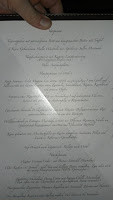
Not all items were available, and the menu changes often, depending on the fresh foods they can obtain. So what did I order? In addition to the designer bottle of mineral water, I had a Paleo antipasti plate as a starter.

The plate had some crackers made with nut flours and other natural ingredients (crunchy and tasty), some dried seeds, two types of fermented vegetables, some carrot chutney, a roasted garlic clove, and a meat sampler. It was served on a stone plate and was very, very tasty.
Here is the main dish (sorry for the poor quality of the photo):

The main dish was a 100% grass fed filet mignon with a garlic and coconut oil topping, a salad, some mashed celery root, and some fermented beet and carrot shreds. I must say this was an exceptionally good choice that delighted my taste buds. I eat a fair amount of steak, including filet mignon, and this was perhaps the most tender piece of beef I have eaten in a good, long time. Perhaps ever. And it was cooked to medium rare perfection.
This was my dessert:

It was an orange custard cake on a Paleo crust, though I am not sure what the crust was made with. This was called a "Primal" dessert choice, not Paleo, since they used butter in the custard (egg yolks, orange blossoms, butter, and spices) and was topped with a small amount of cooked apples. The apples were the only thing that was really sweet about the dessert, but it was perfect and I have lost my sweet tooth anyway.
This was an excellent meal and in all my future trips to Berlin, I will stop by, if it is still open. Which I think it will be, since the restaurant was full on a non-weekend night. I made a reservation a few weeks in advance and I was very glad I did.
The meal was very European in the sense that it took several hours to complete and was served by a professional wait staff who were also very knowledgeable about the Paleo lifestyle. I arrived at 6:30 p.m. and left at 10:00 p.m. The thing I love about European cuisine is the savoir vivre that accompanies the food. You don't do dinner and something else, such as a show, dinner is what you do. You savor the flavors and spend time on conversation. Unfortunately, I was alone, but the experience will be a treasured one for me. And the best possible compliment I can pay Sauvage is this: I will be back the next time I am in town with another group of students. And not because I wish to support Paleo restaurants (though I do), but because the cuisine was simply superb.
Directions using public transportation: Make your way to the Alexanderplatz station on either the S-Bahn or the U-Bahn. From Alexanderplatz, take the U8 (direction Hermannstrasse) and get off at Schonleinstrasse. Head south on Kottbusser Damm for a couple of blocks and turn left at Pflugerstrasse until you get to number 25. All in all, about a 10 minute walk from the Schonleinstrasse U-Bahn station.
First of all, the only lighting in the restaurant was candle light, so most of the following photos are blurry, as my not-so-smart-phone had trouble focusing on the dishes.

Also, this is upscale, fine dining. Berlin has some very inexpensive restaurants, but this one is for the foodies among you, and, consequently, has prices to match. I ordered a starter, main dish, dessert, and bottle of designer mineral water. I do not drink, so wine is not included in my total. I spent 45 euros on the meal, or approximately $60. But I am a foodie and it was so very worth it. The only thing missing from the experience was my wife, who is also a foodie, but who did not accompany me on this trip. The other professors on this study abroad trip had no interest in eating "caveman" food and I know them well enough to know they are not foodies. So I went alone. Melissa McEwan, you are not the only one who dines alone from time to time.
The restaurant is rather small and I doubt it could hold more than 35 to 40 patrons. It was minimally decorated, but that was fine because they only used candles for lighting and you couldn't really see a lot (though there were electric lights in the kitchen and bathrooms). Very Paleo, that. The wait staff was very friendly and helpful, but professional and unobtrusive. They never interrupted my meal to ask me how if I liked it (I hate it when American, non-professional wait staff interrupt my meal to ask me that banal question). The staff at Sauvage only asked about the meal when they removed the plates.
Here is the menu in German (click to enlarge). The wait staff was very helpful with the translations.
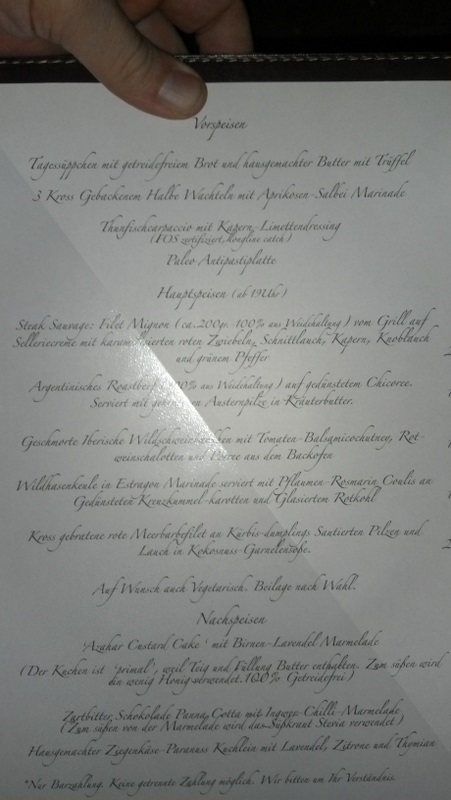
Not all items were available, and the menu changes often, depending on the fresh foods they can obtain. So what did I order? In addition to the designer bottle of mineral water, I had a Paleo antipasti plate as a starter.

The plate had some crackers made with nut flours and other natural ingredients (crunchy and tasty), some dried seeds, two types of fermented vegetables, some carrot chutney, a roasted garlic clove, and a meat sampler. It was served on a stone plate and was very, very tasty.
Here is the main dish (sorry for the poor quality of the photo):

The main dish was a 100% grass fed filet mignon with a garlic and coconut oil topping, a salad, some mashed celery root, and some fermented beet and carrot shreds. I must say this was an exceptionally good choice that delighted my taste buds. I eat a fair amount of steak, including filet mignon, and this was perhaps the most tender piece of beef I have eaten in a good, long time. Perhaps ever. And it was cooked to medium rare perfection.
This was my dessert:

It was an orange custard cake on a Paleo crust, though I am not sure what the crust was made with. This was called a "Primal" dessert choice, not Paleo, since they used butter in the custard (egg yolks, orange blossoms, butter, and spices) and was topped with a small amount of cooked apples. The apples were the only thing that was really sweet about the dessert, but it was perfect and I have lost my sweet tooth anyway.
This was an excellent meal and in all my future trips to Berlin, I will stop by, if it is still open. Which I think it will be, since the restaurant was full on a non-weekend night. I made a reservation a few weeks in advance and I was very glad I did.
The meal was very European in the sense that it took several hours to complete and was served by a professional wait staff who were also very knowledgeable about the Paleo lifestyle. I arrived at 6:30 p.m. and left at 10:00 p.m. The thing I love about European cuisine is the savoir vivre that accompanies the food. You don't do dinner and something else, such as a show, dinner is what you do. You savor the flavors and spend time on conversation. Unfortunately, I was alone, but the experience will be a treasured one for me. And the best possible compliment I can pay Sauvage is this: I will be back the next time I am in town with another group of students. And not because I wish to support Paleo restaurants (though I do), but because the cuisine was simply superb.
Directions using public transportation: Make your way to the Alexanderplatz station on either the S-Bahn or the U-Bahn. From Alexanderplatz, take the U8 (direction Hermannstrasse) and get off at Schonleinstrasse. Head south on Kottbusser Damm for a couple of blocks and turn left at Pflugerstrasse until you get to number 25. All in all, about a 10 minute walk from the Schonleinstrasse U-Bahn station.
Friday, March 9, 2012
Dinner Tonight
I am still trying to decide what to do with this blog, since it is called Low Carb Wisdom and since I no longer believe in the carbohydrate-insulin-fat hypothesis. I have converted to a more ancestral way of eating, more Paleo, more Perfect Health Diet, with a focus on real, whole foods, and without the dogma I see on so many low carb sites. So until I decide what to rename the blog, I thought I would post some photos of what I have been eating. Most people are curious to know what I eat anyway.
Here is a photo of dinner tonight (click to enlarge):

I ate a 250 gram (roughly 8 ounce) Irish rib eye steak (100% grass fed) cooked in a small amount of coconut oil (perhaps one or two teaspoons). Since I am not in Ireland (sad cries), the steak is obviously imported. The salad is what the British call "rocket" (and what the French call roquette); we in the states call this "arugula." The photo also shows some freshly grated Parmesan cheese. For a dressing: olive oil (the good stuff: first cold pressing from Italy) and balsamic vinegar, with a bit of salt and pepper. Two large cups of filtered water to drink, and for dessert, 10 grams of 70% Cote d'Or dark chocolate. Total calories: about 1,000, give or take. I doubt I have consumed more than 2,400 calories today and have walked a lot (13,000 steps and counting).
Blood Glucose reading one hour after eating: 109.
Here is a photo of dinner tonight (click to enlarge):

I ate a 250 gram (roughly 8 ounce) Irish rib eye steak (100% grass fed) cooked in a small amount of coconut oil (perhaps one or two teaspoons). Since I am not in Ireland (sad cries), the steak is obviously imported. The salad is what the British call "rocket" (and what the French call roquette); we in the states call this "arugula." The photo also shows some freshly grated Parmesan cheese. For a dressing: olive oil (the good stuff: first cold pressing from Italy) and balsamic vinegar, with a bit of salt and pepper. Two large cups of filtered water to drink, and for dessert, 10 grams of 70% Cote d'Or dark chocolate. Total calories: about 1,000, give or take. I doubt I have consumed more than 2,400 calories today and have walked a lot (13,000 steps and counting).
Blood Glucose reading one hour after eating: 109.
Friday, February 3, 2012
So What did I Eat?
Several people have asked me about what I ate on my 30-day clean Paleo experiment that helped me to bust through my stall. So I thought I would elaborate.
First of all, let me say I am a tall (6'3"), 50-year-old male. My goal weight is between 215-220 pounds. Also, I tried to keep it simple. I ate very palatable foods, but choices low on food reward. For example, steak, which is very palatable, but does not cause me to want more, as more rewarding foods do. So here is the menu.
Every morning, I ate two fried eggs (cooked in coconut oil) and either some homemade sausage or thick sliced bacon. Plus water.
Lunch was a bit more varied. I would often take a soup made with beef or chicken stock, that contained some meat, but lots of veggies and a safe starch (white potatoes or rice). I tried to have something made with bone broth every day. I would also take a salad, with tuna fish, olives, olive oil, and Balsamic vinegar. Sometimes, I would take a piece of meat that was leftover from dinner (e.g., chicken or ribs) instead of either the soup or salad.
For dinner, I would eat a piece of meat (beef, pork, chicken, salmon or other fish) plus vegetables. If I hadn't eaten a safe starch for lunch, I would also include a small sweet potato. The only condiments I used were salt and pepper.
I rarely snacked, but if I did, it was usually berries of some sort. Upon occasion, I had some herbal mint tea, unsweetened. And I made sure I drank adequate water.
In addition to all of that, I would eat two to three Brazil nuts per day, plus take liver pills. That is, frozen pieces of raw liver that I had chopped up into pill-sized shapes that I could swallow (thanks Chris Kresser for that great idea; I have a hard time with liver). I would also supplement with other vitamins, as per the Perfect Health Diet.
Whenever possible, I practiced intermittent fasting. Sometimes for as much as 24 hours, but mostly I would go 13 to 16 hours between eating. Once dinner was over (usually around 6:00 p.m.), I didn't eat anything else until breakfast the next morning (around 7:00 a.m.; later on weekends).
And it worked beautifully.
First of all, let me say I am a tall (6'3"), 50-year-old male. My goal weight is between 215-220 pounds. Also, I tried to keep it simple. I ate very palatable foods, but choices low on food reward. For example, steak, which is very palatable, but does not cause me to want more, as more rewarding foods do. So here is the menu.
Every morning, I ate two fried eggs (cooked in coconut oil) and either some homemade sausage or thick sliced bacon. Plus water.
Lunch was a bit more varied. I would often take a soup made with beef or chicken stock, that contained some meat, but lots of veggies and a safe starch (white potatoes or rice). I tried to have something made with bone broth every day. I would also take a salad, with tuna fish, olives, olive oil, and Balsamic vinegar. Sometimes, I would take a piece of meat that was leftover from dinner (e.g., chicken or ribs) instead of either the soup or salad.
For dinner, I would eat a piece of meat (beef, pork, chicken, salmon or other fish) plus vegetables. If I hadn't eaten a safe starch for lunch, I would also include a small sweet potato. The only condiments I used were salt and pepper.
I rarely snacked, but if I did, it was usually berries of some sort. Upon occasion, I had some herbal mint tea, unsweetened. And I made sure I drank adequate water.
In addition to all of that, I would eat two to three Brazil nuts per day, plus take liver pills. That is, frozen pieces of raw liver that I had chopped up into pill-sized shapes that I could swallow (thanks Chris Kresser for that great idea; I have a hard time with liver). I would also supplement with other vitamins, as per the Perfect Health Diet.
Whenever possible, I practiced intermittent fasting. Sometimes for as much as 24 hours, but mostly I would go 13 to 16 hours between eating. Once dinner was over (usually around 6:00 p.m.), I didn't eat anything else until breakfast the next morning (around 7:00 a.m.; later on weekends).
And it worked beautifully.
Friday, December 9, 2011
Taking Refuge in the Asylum
So why have I been silent for the past few weeks? The safe starch debate really got to me, especially the smug, sanctimonious responses of many low carbers.
I have decided I no longer want to be identified as a "low carber" and prefer the "Paleo" moniker instead, at least the Perfect Health Diet version of it. Which means I am at a crossroads as to what to do with my blog, as it is called "Low Carb Wisdom." I am seeing there is no wisdom in low carb circles, just dogma. So it's time to hit the exits. I'm not saying I am abondoning the blog, but I am taking... a pause.
In the mean time, I have sought refuge in the Carb Sane Asylum. You might want to check in if you show any sign of these symptoms.
I have decided I no longer want to be identified as a "low carber" and prefer the "Paleo" moniker instead, at least the Perfect Health Diet version of it. Which means I am at a crossroads as to what to do with my blog, as it is called "Low Carb Wisdom." I am seeing there is no wisdom in low carb circles, just dogma. So it's time to hit the exits. I'm not saying I am abondoning the blog, but I am taking... a pause.
In the mean time, I have sought refuge in the Carb Sane Asylum. You might want to check in if you show any sign of these symptoms.
Wednesday, September 21, 2011
Justifying Principles
An epistemological question: why do people believe what they believe about low carb/paleo/ancestral ways of living? What are your justifying principles? I have written before about how tough it is to justify dietary dogmas. But I think I would like to revisit that question in more detail.
It seems to me that in the low carb world, the overarching belief is that "carbs are bad." Gary Taubes, at least as interpreted by his adherents, seems to be a big proponent of this philosophy. According to this view, carbs are fattening, and therefore, cutting carbs causes people to lose weight. But I have actually read Taubes' two main books, and while he is certainly down on carbs, he does seem to be especially down on fructose and refined carbs, not all carbs. Also, this theory is under attack, with many paleo and primal types rejecting it. As Chris Kresser pointed out, just because cutting carbs is a cure to obesity, it doesn't logically follow that carbs cause obesity. We are confusing a cure with a cause.
Yet, as I peruse the Internet, it seems to me the belief that carbs are fattening is widely held. I don't believe this and I personally think that we lose weight on a low carb diet because when we cut out sugar and refined carb products, we spontaneously consume fewer calories, as fat and protein (the foods with which we replace all those carbs we cut) are much more satiating. And limiting your intake of carbs cuts out an awful lot of food choices. That said, if you eat too much low carb food, you will gain weight, especially if you consume too much fat. Calories do matter.
What is the justifying principle for Paleo? Paleo types try to eat what they guess our Paleolithic ancestors ate. For example, J. Stanton of Gnolls.org suggests, "Eat like a predator, not like prey." Unlike low carb dieters, many Paleo adherents don't do dairy, because have you ever tried to milk a wild buffalo? But do we really know what our ancestors ate? It seems to me that a lot of Paleo adherents have a romanticized view of what our ancestors ate. Some Paleo adherents (e.g., Jaminet, Harris) advocate eating "safe" carbs, such as potatoes, rice, tapioca, etc., in addition to adding dairy. Apparently, Harris is currently eating 40% of his calories as carbs, including a lot of Rice Krispies and half and half (you'll have to listen to a rather long [but interesting!] podcast to hear him admit this).
My main problem with Paleo: its justifying principles are rather shaky. I can find all varieties of people who follow the "Paleo" lifestyle: those who do low carb Paleo; those who eat fruit, since not all ancient fruits were small, bitter, and low in sugar; those who will add some dairy to the previous list; those who will add dark chocolate; those who will add rice or potatoes; those who do vegetarian variants of the Paleo lifestyle; those who do low fat Paleo; and those who try to do some version of Paleo, but who cheat, a little or a lot. There have also been some high profile people quit the Paleo lifestyle, such as Don Matesz. Since there is so much argument about what our Paleolithic ancestors ate, it seems to me that members of the "Paleo" community are more united by what they avoid than by what they eat. They avoid things that make modern man sick, such as refined carbs, dairy, seed oils, processed foods, etc.
I actually appreciate all of the discussions within the Paleo community. As General George Patton once said, "If everyone's thinking the same thing, nobody is thinking." At least some thinking and progressing is going on in the Paleo community. Sometimes, it doesn't seem to me like as much thinking is going on in the low carb community. There does seem to be a lot of agreement in most Paleo camps that modern wheat, seed oils, refined carbs, and processed foods are not healthy to consume. The debate about dairy (fermented, cheese, cream), fruit, potatoes, rice, dark chocolate, etc., is actually very healthy. I know it has helped me change my mind on some topics. And at least they avoid nonsensical arguments like, "All carbs are fattening."
It seems to me that in the low carb world, the overarching belief is that "carbs are bad." Gary Taubes, at least as interpreted by his adherents, seems to be a big proponent of this philosophy. According to this view, carbs are fattening, and therefore, cutting carbs causes people to lose weight. But I have actually read Taubes' two main books, and while he is certainly down on carbs, he does seem to be especially down on fructose and refined carbs, not all carbs. Also, this theory is under attack, with many paleo and primal types rejecting it. As Chris Kresser pointed out, just because cutting carbs is a cure to obesity, it doesn't logically follow that carbs cause obesity. We are confusing a cure with a cause.
Yet, as I peruse the Internet, it seems to me the belief that carbs are fattening is widely held. I don't believe this and I personally think that we lose weight on a low carb diet because when we cut out sugar and refined carb products, we spontaneously consume fewer calories, as fat and protein (the foods with which we replace all those carbs we cut) are much more satiating. And limiting your intake of carbs cuts out an awful lot of food choices. That said, if you eat too much low carb food, you will gain weight, especially if you consume too much fat. Calories do matter.
What is the justifying principle for Paleo? Paleo types try to eat what they guess our Paleolithic ancestors ate. For example, J. Stanton of Gnolls.org suggests, "Eat like a predator, not like prey." Unlike low carb dieters, many Paleo adherents don't do dairy, because have you ever tried to milk a wild buffalo? But do we really know what our ancestors ate? It seems to me that a lot of Paleo adherents have a romanticized view of what our ancestors ate. Some Paleo adherents (e.g., Jaminet, Harris) advocate eating "safe" carbs, such as potatoes, rice, tapioca, etc., in addition to adding dairy. Apparently, Harris is currently eating 40% of his calories as carbs, including a lot of Rice Krispies and half and half (you'll have to listen to a rather long [but interesting!] podcast to hear him admit this).
My main problem with Paleo: its justifying principles are rather shaky. I can find all varieties of people who follow the "Paleo" lifestyle: those who do low carb Paleo; those who eat fruit, since not all ancient fruits were small, bitter, and low in sugar; those who will add some dairy to the previous list; those who will add dark chocolate; those who will add rice or potatoes; those who do vegetarian variants of the Paleo lifestyle; those who do low fat Paleo; and those who try to do some version of Paleo, but who cheat, a little or a lot. There have also been some high profile people quit the Paleo lifestyle, such as Don Matesz. Since there is so much argument about what our Paleolithic ancestors ate, it seems to me that members of the "Paleo" community are more united by what they avoid than by what they eat. They avoid things that make modern man sick, such as refined carbs, dairy, seed oils, processed foods, etc.
I actually appreciate all of the discussions within the Paleo community. As General George Patton once said, "If everyone's thinking the same thing, nobody is thinking." At least some thinking and progressing is going on in the Paleo community. Sometimes, it doesn't seem to me like as much thinking is going on in the low carb community. There does seem to be a lot of agreement in most Paleo camps that modern wheat, seed oils, refined carbs, and processed foods are not healthy to consume. The debate about dairy (fermented, cheese, cream), fruit, potatoes, rice, dark chocolate, etc., is actually very healthy. I know it has helped me change my mind on some topics. And at least they avoid nonsensical arguments like, "All carbs are fattening."
Subscribe to:
Posts (Atom)