Several people have asked me about what I ate on my 30-day clean Paleo experiment that helped me to bust through my stall. So I thought I would elaborate.
First of all, let me say I am a tall (6'3"), 50-year-old male. My goal weight is between 215-220 pounds. Also, I tried to keep it simple. I ate very palatable foods, but choices low on food reward. For example, steak, which is very palatable, but does not cause me to want more, as more rewarding foods do. So here is the menu.
Every morning, I ate two fried eggs (cooked in coconut oil) and either some homemade sausage or thick sliced bacon. Plus water.
Lunch was a bit more varied. I would often take a soup made with beef or chicken stock, that contained some meat, but lots of veggies and a safe starch (white potatoes or rice). I tried to have something made with bone broth every day. I would also take a salad, with tuna fish, olives, olive oil, and Balsamic vinegar. Sometimes, I would take a piece of meat that was leftover from dinner (e.g., chicken or ribs) instead of either the soup or salad.
For dinner, I would eat a piece of meat (beef, pork, chicken, salmon or other fish) plus vegetables. If I hadn't eaten a safe starch for lunch, I would also include a small sweet potato. The only condiments I used were salt and pepper.
I rarely snacked, but if I did, it was usually berries of some sort. Upon occasion, I had some herbal mint tea, unsweetened. And I made sure I drank adequate water.
In addition to all of that, I would eat two to three Brazil nuts per day, plus take liver pills. That is, frozen pieces of raw liver that I had chopped up into pill-sized shapes that I could swallow (thanks Chris Kresser for that great idea; I have a hard time with liver). I would also supplement with other vitamins, as per the Perfect Health Diet.
Whenever possible, I practiced intermittent fasting. Sometimes for as much as 24 hours, but mostly I would go 13 to 16 hours between eating. Once dinner was over (usually around 6:00 p.m.), I didn't eat anything else until breakfast the next morning (around 7:00 a.m.; later on weekends).
And it worked beautifully.
Showing posts with label stall. Show all posts
Showing posts with label stall. Show all posts
Friday, February 3, 2012

Wednesday, December 14, 2011
Low Carb Fairy Tales
Obesity is a complex problem. But, as is human tendency, we want a simple answer to a complex problem. And low carb is a simple answer. Yes, you can lose weight, but this is almost by accident, as when you go low carb, you cut out wheat and sugar, two very problematic things.
Low carb proponents tell the obese exactly what they want to hear:
1) It's not my fault I am fat; my metabolism is broken.
2) I can eat all the fat and protein I want and still lose weight, because low carb gives me a metabolic advantage.
3) Calories don't count, only carbs matter, since all carbs are fattening.
4) Exercise doesn't matter.
5) Carbs increase insulin, which increases fat storage. Cut the carbs and burn fat.
6) Add yummy fat to your diet to be even more healthy and speed up weight loss.
Isn't that nice? Only it's not true: it's merely a fairy tale, with very little empirical science to back it up.
But it is one heck of a persuasive argument to tell an obese person. It shifts the blame from your willpower to something you can't control: an out of whack metabolism. And it worked! At least at first. Then it stalled as it always does after 17-20% weight loss and I got wiser.
It was like learning that Santa Claus is not real: low carb is not the magic weight loss bullet I thought it was.
What I really wanted was a simple solution to what I now know is a complex problem. I didn't want my being fat to be blamed on my sloth and gluttony, I wanted another explanation (broken metabolism, fattening carbs!). I didn't want to exercise and I didn't want to count calories. I wanted to eat until I was full and lose weight. Nice, neat, simple, compelling, and wrong.
I am currently following the Perfect Health Diet, a scientifically developed Paleo diet that is not based on fairy tales and which encourages exercise and calorie counting, is already high fat (you don't have to add any more), and complex. But that is okay, because I no longer believe in Santa Claus.
Low carb proponents tell the obese exactly what they want to hear:
1) It's not my fault I am fat; my metabolism is broken.
2) I can eat all the fat and protein I want and still lose weight, because low carb gives me a metabolic advantage.
3) Calories don't count, only carbs matter, since all carbs are fattening.
4) Exercise doesn't matter.
5) Carbs increase insulin, which increases fat storage. Cut the carbs and burn fat.
6) Add yummy fat to your diet to be even more healthy and speed up weight loss.
Isn't that nice? Only it's not true: it's merely a fairy tale, with very little empirical science to back it up.
But it is one heck of a persuasive argument to tell an obese person. It shifts the blame from your willpower to something you can't control: an out of whack metabolism. And it worked! At least at first. Then it stalled as it always does after 17-20% weight loss and I got wiser.
It was like learning that Santa Claus is not real: low carb is not the magic weight loss bullet I thought it was.
What I really wanted was a simple solution to what I now know is a complex problem. I didn't want my being fat to be blamed on my sloth and gluttony, I wanted another explanation (broken metabolism, fattening carbs!). I didn't want to exercise and I didn't want to count calories. I wanted to eat until I was full and lose weight. Nice, neat, simple, compelling, and wrong.
I am currently following the Perfect Health Diet, a scientifically developed Paleo diet that is not based on fairy tales and which encourages exercise and calorie counting, is already high fat (you don't have to add any more), and complex. But that is okay, because I no longer believe in Santa Claus.
Tuesday, September 20, 2011
Stalled Again
I think I have officially stalled again. For one month now, I have been hanging around the 242-243 pound range. The good news is that almost without effort, my weight has stabilized in a range that is sixty pounds lower than when I started. The bad news is, I am still about 25 pounds away from goal.
Weight Watchers took me all the way down to goal, but it was a miserable experience. Low carb/paleo/Perfect Health Diet has been a much better, overall way to lose weight. I am healthier, I am not hungry, and my type II diabetes is effectively in remission. Yet, I cannot seem to get down to where I want to be. And this is a rather common problem when low carb dieting. What to do? I don't really know yet.
Weight Watchers took me all the way down to goal, but it was a miserable experience. Low carb/paleo/Perfect Health Diet has been a much better, overall way to lose weight. I am healthier, I am not hungry, and my type II diabetes is effectively in remission. Yet, I cannot seem to get down to where I want to be. And this is a rather common problem when low carb dieting. What to do? I don't really know yet.
Wednesday, August 24, 2011
Counting Calories Works For Me
To misquote James Carville, "It's the calories, stupid." I have successfully broken through my stall, by limiting my calories. I bought into the low carb hype about a "metabolic advantage" and the idea that "calories don't count." About four weeks ago when I started slowing down in my weight loss I decided to restrict calories, since some voices I respect talked about the necessity of counting calories.
Thinking back on it, it is remarkable that I lost almost 50 pounds without counting anything except grams of carbs. I guess that shows how overweight I was. The greater satiety from eating fat and protein filled me up and I spontaneously consumed fewer calories, which directly led to the weight loss. However, as I am losing weight, my metabolism is adjusting as well, and the weight loss started slowing, then stalled. But since I started counting calories (and exercising more), I have started losing weight again. Even though I have been restricting calories (using the free livestrong.com program), I am still not hungry most of the time, so this is clearly the way to go. I guess it helps that, with exercise, I can consume 2,700 calories per day and still lose weight. Only about thirty pounds to go until I hit my goal.
"Low carb" is still the way to go, as it is a much more pleasant weight loss experience. However, I think I am redefining in my own mind what "low carb" actually means. But that is the subject for another day.
Thinking back on it, it is remarkable that I lost almost 50 pounds without counting anything except grams of carbs. I guess that shows how overweight I was. The greater satiety from eating fat and protein filled me up and I spontaneously consumed fewer calories, which directly led to the weight loss. However, as I am losing weight, my metabolism is adjusting as well, and the weight loss started slowing, then stalled. But since I started counting calories (and exercising more), I have started losing weight again. Even though I have been restricting calories (using the free livestrong.com program), I am still not hungry most of the time, so this is clearly the way to go. I guess it helps that, with exercise, I can consume 2,700 calories per day and still lose weight. Only about thirty pounds to go until I hit my goal.
"Low carb" is still the way to go, as it is a much more pleasant weight loss experience. However, I think I am redefining in my own mind what "low carb" actually means. But that is the subject for another day.
Sunday, August 14, 2011
Thinking Through Diet Options
The recent Internet firestorm involving Gary Taubes and Stephan Guyenet has left me with a lot of questions.
As a weight loss method, low carb works--to a point. I have lost 55 pounds in six months, but I am still 30 pounds from my goal weight and I am stalled. There is a lot of chatter on the Internet about stalls: they happen after you lose between 17 and 20% of your body weight. I have lost about 18% of my body weight fairly effortlessly without really counting anything on a low carb diet, then I stalled, and am now counting calories to break through the stall. So far, I am very slowly creeping downward.
Is Taubes wrong? Is the problem carbohydrates, or something else? Clearly, what he advocates (reducing carbs) works, at least to a point, and at least for me. But why does it work? In substantially reducing carbs, I have cut out all forms of wheat and most forms of sugar, two carbs widely believed to be problematic. Heck, even the low fat, high carb dieters come out against sugar. But is Taubes condemning all carbs, when only some of them are bad? Isn't this what happened with fat? Ancel Keys waged war against saturated fat and now America is lipophobic (afraid of fat). Taubes describes the complete history of the Keys and the lipid hypothesis ("saturated fats cause heart disease") in Good Calories Bad Calories.
Is Gary Taubes doing the same thing to carbohydrates? One person described Taubes as the "Ancel Keys of carbohydrates." Ouch, that's gotta hurt. But Taubes is relentlessly promoting the "carbs are bad, carbs --> insulin --> fat accumulation" hypothesis. So the comment may hurt because there is more than a ring of truth to it. Is Taubes pushing a solution that is potentially as bad, in its own way, as Keys' agenda was? America is now lipophobic; will Taubes cause us to become carbophobic as well?
Many in the low carb blogosphere point out that carbs are not bad across the board. Certain foods, which happen to be carbohydrates, are bad (e.g., high fructose corn syrup, sugar, flour and wheat products, etc.; see Kurt Harris, M.D. and Paul Jaminet, Ph.D. [see this page, too] ). But vegetable oils, such as corn, soy, canola, etc., are also bad, according to these two sites, and they are fats, not carbohydrates. Kurt Harris tells us to ignore macro nutrients (fats, carbs, protein) altogether and instead avoid the NADs, or "neolithic agents of disease." In other words, fructose, wheat, and vegetable oils. Both Harris and Jaminet are okay with eating non-problematic carbs such as white rice, yams, and potatoes. However, neither Harris nor Jaminet are diabetic and their plans for eating are not necessarily approaches to weight loss.
So I could see myself following one of these plans (or adopting the Weston A. Price style of eating), after I lose my weight. However, I am still 30 pounds away from goal. What to do? Low carbing has helped me to lose weight, control my blood sugars, normalize my blood pressure, and sleep better, but can it get me all the way to goal? Weight Watchers took me all the way to goal, but that is a semi-starvation plan and high in carbs, which is not good for my type II diabetes.
After a lot of thought, I will keep on with the low carb way of life (but I will double my carbs), count calories, exercise more, and perhaps other things (e.g., eliminate all artificial sweeteners, eat only whole, real foods), if necessary, until I reach my goal. However, I am very open to suggestions. When I am at goal, I will likely switch to one of the plans mentioned above for weight maintenance and general health.
As a weight loss method, low carb works--to a point. I have lost 55 pounds in six months, but I am still 30 pounds from my goal weight and I am stalled. There is a lot of chatter on the Internet about stalls: they happen after you lose between 17 and 20% of your body weight. I have lost about 18% of my body weight fairly effortlessly without really counting anything on a low carb diet, then I stalled, and am now counting calories to break through the stall. So far, I am very slowly creeping downward.
Is Taubes wrong? Is the problem carbohydrates, or something else? Clearly, what he advocates (reducing carbs) works, at least to a point, and at least for me. But why does it work? In substantially reducing carbs, I have cut out all forms of wheat and most forms of sugar, two carbs widely believed to be problematic. Heck, even the low fat, high carb dieters come out against sugar. But is Taubes condemning all carbs, when only some of them are bad? Isn't this what happened with fat? Ancel Keys waged war against saturated fat and now America is lipophobic (afraid of fat). Taubes describes the complete history of the Keys and the lipid hypothesis ("saturated fats cause heart disease") in Good Calories Bad Calories.
Is Gary Taubes doing the same thing to carbohydrates? One person described Taubes as the "Ancel Keys of carbohydrates." Ouch, that's gotta hurt. But Taubes is relentlessly promoting the "carbs are bad, carbs --> insulin --> fat accumulation" hypothesis. So the comment may hurt because there is more than a ring of truth to it. Is Taubes pushing a solution that is potentially as bad, in its own way, as Keys' agenda was? America is now lipophobic; will Taubes cause us to become carbophobic as well?
Many in the low carb blogosphere point out that carbs are not bad across the board. Certain foods, which happen to be carbohydrates, are bad (e.g., high fructose corn syrup, sugar, flour and wheat products, etc.; see Kurt Harris, M.D. and Paul Jaminet, Ph.D. [see this page, too] ). But vegetable oils, such as corn, soy, canola, etc., are also bad, according to these two sites, and they are fats, not carbohydrates. Kurt Harris tells us to ignore macro nutrients (fats, carbs, protein) altogether and instead avoid the NADs, or "neolithic agents of disease." In other words, fructose, wheat, and vegetable oils. Both Harris and Jaminet are okay with eating non-problematic carbs such as white rice, yams, and potatoes. However, neither Harris nor Jaminet are diabetic and their plans for eating are not necessarily approaches to weight loss.
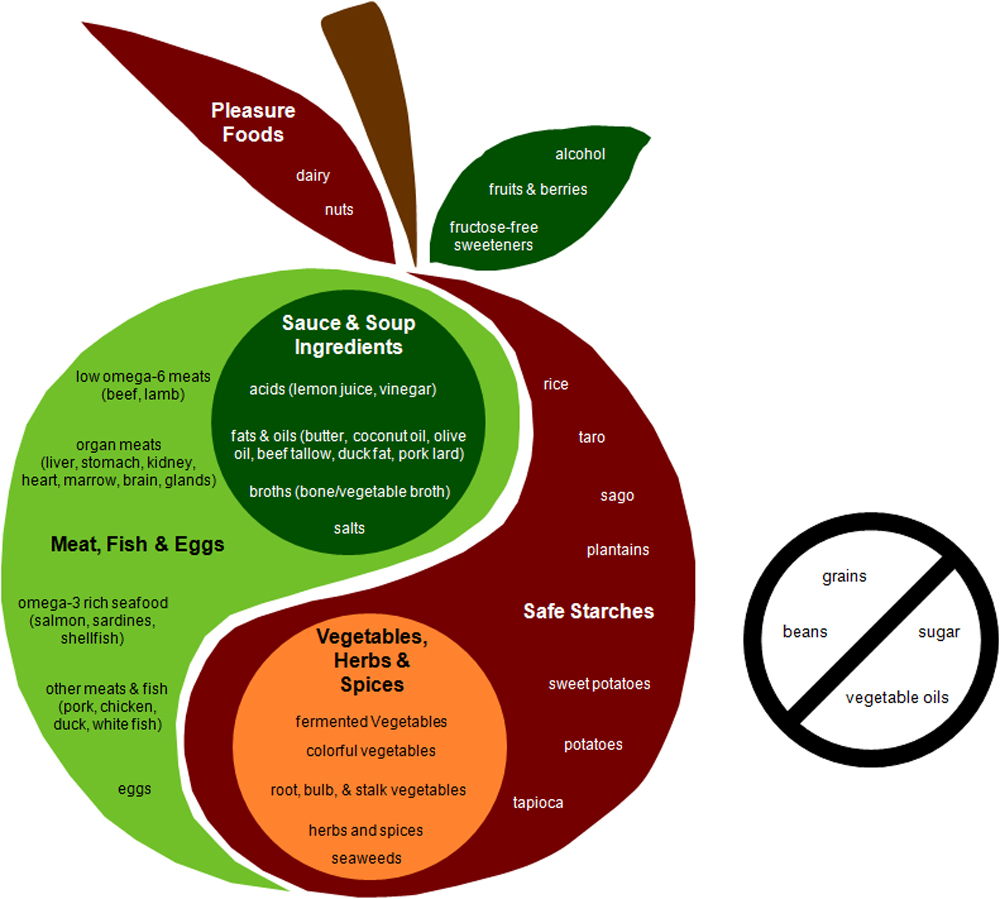
So I could see myself following one of these plans (or adopting the Weston A. Price style of eating), after I lose my weight. However, I am still 30 pounds away from goal. What to do? Low carbing has helped me to lose weight, control my blood sugars, normalize my blood pressure, and sleep better, but can it get me all the way to goal? Weight Watchers took me all the way to goal, but that is a semi-starvation plan and high in carbs, which is not good for my type II diabetes.
After a lot of thought, I will keep on with the low carb way of life (but I will double my carbs), count calories, exercise more, and perhaps other things (e.g., eliminate all artificial sweeteners, eat only whole, real foods), if necessary, until I reach my goal. However, I am very open to suggestions. When I am at goal, I will likely switch to one of the plans mentioned above for weight maintenance and general health.
Subscribe to:
Posts (Atom)