In a recent post, I speculated on reasons why people are obese. In many ways, this current post is the opposite: why do low carb diets reduce obese people to slender people? There are a lot of claims on the Internet about why low carb diets work, some of them quite outrageous, and I want to seek wisdom on this topic.
The Carbohydrate Hypothesis. Gary Taubes is the leading proponent of the hypothesis that carbs, especially refined carbs like flour and sugar, are fattening. This is also known as the "carbohydrate hypothesis." According to Taubes, carbs lead to insulin spikes, which leads to fat deposition (accumulation). The "carbohydrate hypothesis" is widely disputed and to date, there is no empirical evidence to back it up, though Taubes is apparently trying to raise money for such an empirical test. Personally, I no longer believe this theory, though at one time, I was a believer. True believers in this hypothesis include Jimmy Moore, Dana Carpender, Gary Taubes (of course), and Tom Naughton, among many others.
Metabolic Advantage. Others suggest that a low carb diet gives you a metabolic advantage (the idea that you burn calories more efficiently while low carbing, and can therefore consume greater quantities of low carb food and still lose weight), though at present there is very little empirical evidence to back up this claim. This idea is also widely disputed, as exemplified by the dust-up between Michael Eades and Anthony Colpo on this very topic. The metabolic advantage theory leads to the idea that calories don't count, that some calories (e.g., "low carb" calories") are better than other calories. Thus, if you eat low carb, you don't have to worry about calories. I am also on record as rejecting this idea.
Satiety. Another theory about why low carb diets work is that protein and fat are more satiating (see this article, too). When you eat a high fat, moderate protein, low carb diet you lose weight because you spontaneously consume fewer calories. There seems to be a lot more evidence for this theory (e.g., here, here, and here). Note, too, that this theory implicitly rejects the theory of metabolic advantage mentioned above. I am on record as saying this is a major reason why low carb works.
Toxins, Infections, and Malnutrition. The Perfect Health Diet maintains that weight loss happens when you eliminate toxins from your diet, as well as malnutrition and infections caused by your diet. The Jaminets have developed a diet based on these three ideas, which is summarized here. The diet is a low carb diet that includes so-called "safe starches," such as potatoes and white rice. A "safe starch" has nothing to do with carb or glucose content. It is a term invented by the Jaminets and "refers to any starchy food which, after normal cooking, lacks toxins, chiefly protein toxins. We do not consider glucose to be a toxin, though it may become toxic in hyperglycemia" (reference). Their definition of a low carb diet is one between 100 to 150 grams of carbs per day, mostly from "safe starches," as a low carb diet for them "means eating less than the body's actual glucose utilization, so that a glucose deficit has to be made up by gluconeogenesis" (reference). But weight loss happens not because carbs are reduced, but because toxins are eliminated, infections are reduced, and malnutrition is aggressively attacked. I am currently following the Perfect Health Diet, so I guess you could say I am a believer in this hypothesis.
Low Carb Works by Accident. Kurt Harris, M.D., maintains that low carb diets work by accident. Specifically, he says:
Low carb plans have helped people lose fat by reducing food reward from white flour and excess sugar and maybe linoleic acid. This is by accident as it happens that most of the "carbs" in our diet are coming in the form of manufactured and processed items that are simply not real food. Low carb does not work for most people via blood sugar or insulin "locking away" fat. Insulin is necessary to store fat, but is not the main hormone regulating fat storage. That would be leptin. (emphasis added).
Food reward is an idea championed by Stephan Guyenet and the basic idea is that highly palatable foods lead to obesity. Lowering food reward, or palatability, by reducing refined sugars, flours, and even salt and other spices to produce more bland eating options leads to losing weight. The idea proposed by Harris and Guyenet is that low carb diets work, not by design, but by accident. By following Atkins, for example, you naturally reduce food reward by eliminating a whole macronutrient category, carbohydrates. As the Harris quote above indicates, he (and Guyenet) both reject Taubes' carbohydrate hypothesis.
This is a curious argument, one that makes a certain amount of sense. Why does Atkins work? If you follow Atkins, you eliminate two major problematic foods: refined sugars and refined flour. This will naturally lead to weight loss. Atkins is not too concerned about seed oils, though, which is why I don't claim to be following Atkins. My version of a low carb diet has eliminated seed oils from a very early stage in my weight loss history. Atkins also produces a lot of junk food, made with wheat gluten, soy, and other products I don't consume. An Atkins low carb diet is not necessarily a low calorie diet, if you eat too much low carb junk food. So I do think there is an element of "accident" in why low carb works.
My Position. I believe low carb works because 1) protein and fat are more satiating than carbs; 2) low carb eating causes me to spontaneously consume fewer calories, since protein and fat are more satiating than carbs; 3) calories count, so be mindful of how much you eat; 4) low carb lowers food reward by eliminating sugar, flour, and seed oils, especially those three in combination; 5) low carb removes toxins, reduces infections, and corrects malnutrition; 6) low carb requires that I eat real foods, the kind that are not processed; and 7) low carb simply offers fewer food choices. It is a lot harder to snack and harder to eat out, at least in the U.S.A. This means I eat real food cooked at home more often than not. Fortunately, my desire to snack is greatly reduced thanks to the satiety of what I eat.
I do not believe in the carbohydrate hypothesis and reject the notion that carbs are inherently fattening (this idea seems to be widely believed and held on the Internet). Rejecting this idea opened my mind to the idea of eating "safe starches," as defined by the Jaminets. I also reject the idea of metabolic advantage and believe that calories count. Thus, I would never substitute a cup of heavy cream for a cup of whole milk, simply because there are fewer carbs in the cream than in the milk, nor would I add 12 tablespoons of fat to two pounds of meat to increase the fat content of my diet That is simply too many calories and a low carb diet is already a high fat, moderate protein, low carb way of eating. You don't need to add a lot of additional fat.
Taken together, the seven reasons cited above are a recipe for low carb success.
Showing posts with label archevore. Show all posts
Showing posts with label archevore. Show all posts
Saturday, October 22, 2011

Tuesday, September 27, 2011
Why We Get Fat, According to...
Gary Taubes blames carbs, especially the refined carbs like wheat and sugar.
Laura Dolson is generally with Taubes on the refined carbs, but she also blames marketing.
<Rant>
As a marketing professor, I find straw men arguments like this patently ridiculous. Marketing is not all powerful; if it were, I would have created a junk product and marketed it to all of you idiots out there, who would have bought it. You wouldn't have a choice; marketing would have forced you to buy it, and I could retire in style to the French Riviera. Unfortunately, life isn't like that. Consumers have brains and can choose to not purchase marketed products. Up to 95% of new products fail, despite massive amounts of marketing. The influence of the home can swamp any marketing campaign. Massive amounts of food industry marketing do not work on me, for example, or the example I set in my family. I have a brain and I choose differently.
Also, does marketing/advertising create food attitudes, or merely reflect already existing attitudes in people? Any competent social scientist will tell you it is very hard to change behavior. While I think marketing can help to create attitudes, it mostly reflects what already exists. Take smoking, for example. Reasons people smoke include parental example/rebellion against parents; peer pressure; stress and anxiety reductions; desire to lose weight, etc. Marketing, though often blamed for smoking (Exhibit A: Joe Camel), is not even mentioned as a factor (I would argue that marketing only informs brand choice, not the decision to smoke). Get real, folks. Marketing is just not as powerful as you would like to believe. It may be a convenient whipping boy, but your belief in the absolute power of marketing is a fantasy.
</Rant>
Kurt Harris blames the Neolithic Agents of Disease, including fructose, wheat, and seed oils.
Stephan Guyenet blames highly palatable food choices for weight gain.
Paul Jaminet blames malnutrition, dietary toxins, and infections for obesity.
Chris Kresser says there is no single cause of or treatment for obesity. Later, he says that modern lifestyle + genetic predisposition = obesity.
What do I believe? I used to believe Gary Taubes, because the solution he proposed worked for me, to a point. Harris, Jaminet, and Kresser are all singing variations of the same tune, so I suppose I am in their camp now. I am following the Perfect Health Diet, though I am stalled at the moment. They seem the most reasonable, the most scientifically based, even though I have criticized science as a justifying principle for belief. But I guess I have to hang my hat somewhere.
Laura Dolson is generally with Taubes on the refined carbs, but she also blames marketing.
<Rant>
As a marketing professor, I find straw men arguments like this patently ridiculous. Marketing is not all powerful; if it were, I would have created a junk product and marketed it to all of you idiots out there, who would have bought it. You wouldn't have a choice; marketing would have forced you to buy it, and I could retire in style to the French Riviera. Unfortunately, life isn't like that. Consumers have brains and can choose to not purchase marketed products. Up to 95% of new products fail, despite massive amounts of marketing. The influence of the home can swamp any marketing campaign. Massive amounts of food industry marketing do not work on me, for example, or the example I set in my family. I have a brain and I choose differently.
Also, does marketing/advertising create food attitudes, or merely reflect already existing attitudes in people? Any competent social scientist will tell you it is very hard to change behavior. While I think marketing can help to create attitudes, it mostly reflects what already exists. Take smoking, for example. Reasons people smoke include parental example/rebellion against parents; peer pressure; stress and anxiety reductions; desire to lose weight, etc. Marketing, though often blamed for smoking (Exhibit A: Joe Camel), is not even mentioned as a factor (I would argue that marketing only informs brand choice, not the decision to smoke). Get real, folks. Marketing is just not as powerful as you would like to believe. It may be a convenient whipping boy, but your belief in the absolute power of marketing is a fantasy.
</Rant>
Kurt Harris blames the Neolithic Agents of Disease, including fructose, wheat, and seed oils.
Stephan Guyenet blames highly palatable food choices for weight gain.
Paul Jaminet blames malnutrition, dietary toxins, and infections for obesity.
Chris Kresser says there is no single cause of or treatment for obesity. Later, he says that modern lifestyle + genetic predisposition = obesity.
What do I believe? I used to believe Gary Taubes, because the solution he proposed worked for me, to a point. Harris, Jaminet, and Kresser are all singing variations of the same tune, so I suppose I am in their camp now. I am following the Perfect Health Diet, though I am stalled at the moment. They seem the most reasonable, the most scientifically based, even though I have criticized science as a justifying principle for belief. But I guess I have to hang my hat somewhere.
Sunday, August 14, 2011
Thinking Through Diet Options
The recent Internet firestorm involving Gary Taubes and Stephan Guyenet has left me with a lot of questions.
As a weight loss method, low carb works--to a point. I have lost 55 pounds in six months, but I am still 30 pounds from my goal weight and I am stalled. There is a lot of chatter on the Internet about stalls: they happen after you lose between 17 and 20% of your body weight. I have lost about 18% of my body weight fairly effortlessly without really counting anything on a low carb diet, then I stalled, and am now counting calories to break through the stall. So far, I am very slowly creeping downward.
Is Taubes wrong? Is the problem carbohydrates, or something else? Clearly, what he advocates (reducing carbs) works, at least to a point, and at least for me. But why does it work? In substantially reducing carbs, I have cut out all forms of wheat and most forms of sugar, two carbs widely believed to be problematic. Heck, even the low fat, high carb dieters come out against sugar. But is Taubes condemning all carbs, when only some of them are bad? Isn't this what happened with fat? Ancel Keys waged war against saturated fat and now America is lipophobic (afraid of fat). Taubes describes the complete history of the Keys and the lipid hypothesis ("saturated fats cause heart disease") in Good Calories Bad Calories.
Is Gary Taubes doing the same thing to carbohydrates? One person described Taubes as the "Ancel Keys of carbohydrates." Ouch, that's gotta hurt. But Taubes is relentlessly promoting the "carbs are bad, carbs --> insulin --> fat accumulation" hypothesis. So the comment may hurt because there is more than a ring of truth to it. Is Taubes pushing a solution that is potentially as bad, in its own way, as Keys' agenda was? America is now lipophobic; will Taubes cause us to become carbophobic as well?
Many in the low carb blogosphere point out that carbs are not bad across the board. Certain foods, which happen to be carbohydrates, are bad (e.g., high fructose corn syrup, sugar, flour and wheat products, etc.; see Kurt Harris, M.D. and Paul Jaminet, Ph.D. [see this page, too] ). But vegetable oils, such as corn, soy, canola, etc., are also bad, according to these two sites, and they are fats, not carbohydrates. Kurt Harris tells us to ignore macro nutrients (fats, carbs, protein) altogether and instead avoid the NADs, or "neolithic agents of disease." In other words, fructose, wheat, and vegetable oils. Both Harris and Jaminet are okay with eating non-problematic carbs such as white rice, yams, and potatoes. However, neither Harris nor Jaminet are diabetic and their plans for eating are not necessarily approaches to weight loss.
So I could see myself following one of these plans (or adopting the Weston A. Price style of eating), after I lose my weight. However, I am still 30 pounds away from goal. What to do? Low carbing has helped me to lose weight, control my blood sugars, normalize my blood pressure, and sleep better, but can it get me all the way to goal? Weight Watchers took me all the way to goal, but that is a semi-starvation plan and high in carbs, which is not good for my type II diabetes.
After a lot of thought, I will keep on with the low carb way of life (but I will double my carbs), count calories, exercise more, and perhaps other things (e.g., eliminate all artificial sweeteners, eat only whole, real foods), if necessary, until I reach my goal. However, I am very open to suggestions. When I am at goal, I will likely switch to one of the plans mentioned above for weight maintenance and general health.
As a weight loss method, low carb works--to a point. I have lost 55 pounds in six months, but I am still 30 pounds from my goal weight and I am stalled. There is a lot of chatter on the Internet about stalls: they happen after you lose between 17 and 20% of your body weight. I have lost about 18% of my body weight fairly effortlessly without really counting anything on a low carb diet, then I stalled, and am now counting calories to break through the stall. So far, I am very slowly creeping downward.
Is Taubes wrong? Is the problem carbohydrates, or something else? Clearly, what he advocates (reducing carbs) works, at least to a point, and at least for me. But why does it work? In substantially reducing carbs, I have cut out all forms of wheat and most forms of sugar, two carbs widely believed to be problematic. Heck, even the low fat, high carb dieters come out against sugar. But is Taubes condemning all carbs, when only some of them are bad? Isn't this what happened with fat? Ancel Keys waged war against saturated fat and now America is lipophobic (afraid of fat). Taubes describes the complete history of the Keys and the lipid hypothesis ("saturated fats cause heart disease") in Good Calories Bad Calories.
Is Gary Taubes doing the same thing to carbohydrates? One person described Taubes as the "Ancel Keys of carbohydrates." Ouch, that's gotta hurt. But Taubes is relentlessly promoting the "carbs are bad, carbs --> insulin --> fat accumulation" hypothesis. So the comment may hurt because there is more than a ring of truth to it. Is Taubes pushing a solution that is potentially as bad, in its own way, as Keys' agenda was? America is now lipophobic; will Taubes cause us to become carbophobic as well?
Many in the low carb blogosphere point out that carbs are not bad across the board. Certain foods, which happen to be carbohydrates, are bad (e.g., high fructose corn syrup, sugar, flour and wheat products, etc.; see Kurt Harris, M.D. and Paul Jaminet, Ph.D. [see this page, too] ). But vegetable oils, such as corn, soy, canola, etc., are also bad, according to these two sites, and they are fats, not carbohydrates. Kurt Harris tells us to ignore macro nutrients (fats, carbs, protein) altogether and instead avoid the NADs, or "neolithic agents of disease." In other words, fructose, wheat, and vegetable oils. Both Harris and Jaminet are okay with eating non-problematic carbs such as white rice, yams, and potatoes. However, neither Harris nor Jaminet are diabetic and their plans for eating are not necessarily approaches to weight loss.
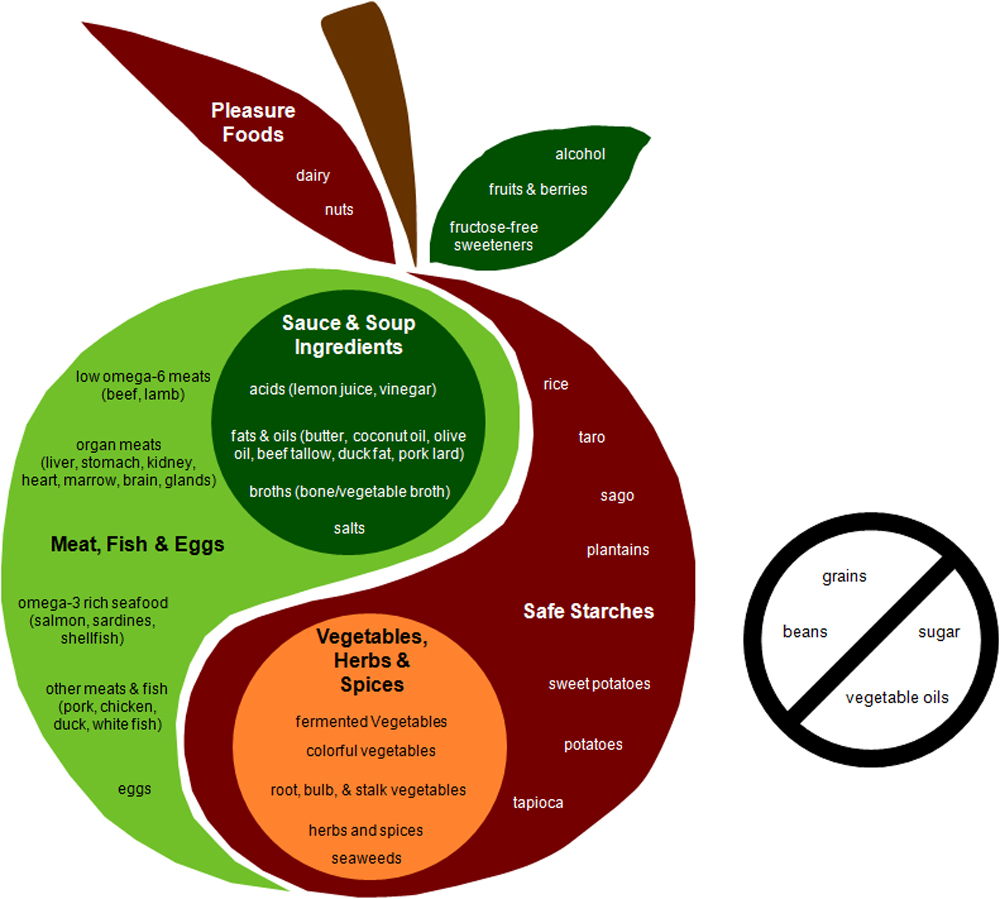
So I could see myself following one of these plans (or adopting the Weston A. Price style of eating), after I lose my weight. However, I am still 30 pounds away from goal. What to do? Low carbing has helped me to lose weight, control my blood sugars, normalize my blood pressure, and sleep better, but can it get me all the way to goal? Weight Watchers took me all the way to goal, but that is a semi-starvation plan and high in carbs, which is not good for my type II diabetes.
After a lot of thought, I will keep on with the low carb way of life (but I will double my carbs), count calories, exercise more, and perhaps other things (e.g., eliminate all artificial sweeteners, eat only whole, real foods), if necessary, until I reach my goal. However, I am very open to suggestions. When I am at goal, I will likely switch to one of the plans mentioned above for weight maintenance and general health.
Subscribe to:
Posts (Atom)