Low carb diets stall if you need to lose more than 17-19% of your body weight. That's the dirty little secret about low carb diets, one that I wish I had known. Weight Watchers took me all the way to goal, but low carb stalls. This has left me about 25-30 pounds short of my goal.
The good news is that I am weight stable; the bad news is that I am no longer going down. This is also very common.
Gary Taubes slickly warned us all of this phenomenon in his book, Why We Get Fat. So I can't say I wasn't warned, but he sugar coats the reality. The following quote is from pp. 204-205 of the 2010 hardback edition of his book:
"The fewer carbohydrates we consume, the leaner we will be. This is clear. But there's no guarantee that the leanest we can be will ever be as lean as we'd like. This is a reality to be faced... [I]f you are not actively losing fat and yet want to be leaner still, the only viable option (short of surgery or the prospect that the pharmaceutical industry will come through with a safe and effective anti-obesity pill) is to eat still fewer carbohydrates, identify and avoid other foods that might stimulate significant insulin secretion--diet sodas, dairy products (cream, for instance), coffee, and nots, among others--and have more patience." (The bold and italicized emphasis is mine).
Why is this aspect of the low carb experience not given more exposure? I had to learn about it by reading the What They Don't Tell You About Low Carb Diets web site (a very good web site, which I highly recommend). And is patience the only way to get to goal? Carbsane has stalled, but been weight stable, for over three years now. How much more patience is needed? Lots of suggestions for busting through stalls, such as drinking more water, intermittent fasting (Taubes on p. 205 of the book referenced above), counting calories, etc.
Or perhaps low carb is not the answer, or at least, not the entire answer, to losing weight. I do not want to remain obese, even if other health markers are good (e.g., normal blood pressure, stabilized blood glucose levels). That is not a good strategy.
So over the next few months, I am going to explore other options. I remain committed to the Perfect Health Diet way of eating, but I am going to aggressively monitor calories and experiment with various foods that may or may not be causing me to stall. I have a goal in mind: I will be taking a group of students on a study abroad trip to Europe this summer (gratuitous link to my study abroad blog) and I want to be thin enough to go paragliding in Interlaken, Switzerland. The upper limit is 220 pounds, so that is my goal. I should be able to lose another 25 pounds in the next six months or so and be ready for the paragliding activity.
Showing posts with label low carb. Show all posts
Showing posts with label low carb. Show all posts
Monday, December 26, 2011

Saturday, October 22, 2011
How Does Low Carb Work? A Review of Various Theories
In a recent post, I speculated on reasons why people are obese. In many ways, this current post is the opposite: why do low carb diets reduce obese people to slender people? There are a lot of claims on the Internet about why low carb diets work, some of them quite outrageous, and I want to seek wisdom on this topic.
The Carbohydrate Hypothesis. Gary Taubes is the leading proponent of the hypothesis that carbs, especially refined carbs like flour and sugar, are fattening. This is also known as the "carbohydrate hypothesis." According to Taubes, carbs lead to insulin spikes, which leads to fat deposition (accumulation). The "carbohydrate hypothesis" is widely disputed and to date, there is no empirical evidence to back it up, though Taubes is apparently trying to raise money for such an empirical test. Personally, I no longer believe this theory, though at one time, I was a believer. True believers in this hypothesis include Jimmy Moore, Dana Carpender, Gary Taubes (of course), and Tom Naughton, among many others.
Metabolic Advantage. Others suggest that a low carb diet gives you a metabolic advantage (the idea that you burn calories more efficiently while low carbing, and can therefore consume greater quantities of low carb food and still lose weight), though at present there is very little empirical evidence to back up this claim. This idea is also widely disputed, as exemplified by the dust-up between Michael Eades and Anthony Colpo on this very topic. The metabolic advantage theory leads to the idea that calories don't count, that some calories (e.g., "low carb" calories") are better than other calories. Thus, if you eat low carb, you don't have to worry about calories. I am also on record as rejecting this idea.
Satiety. Another theory about why low carb diets work is that protein and fat are more satiating (see this article, too). When you eat a high fat, moderate protein, low carb diet you lose weight because you spontaneously consume fewer calories. There seems to be a lot more evidence for this theory (e.g., here, here, and here). Note, too, that this theory implicitly rejects the theory of metabolic advantage mentioned above. I am on record as saying this is a major reason why low carb works.
Toxins, Infections, and Malnutrition. The Perfect Health Diet maintains that weight loss happens when you eliminate toxins from your diet, as well as malnutrition and infections caused by your diet. The Jaminets have developed a diet based on these three ideas, which is summarized here. The diet is a low carb diet that includes so-called "safe starches," such as potatoes and white rice. A "safe starch" has nothing to do with carb or glucose content. It is a term invented by the Jaminets and "refers to any starchy food which, after normal cooking, lacks toxins, chiefly protein toxins. We do not consider glucose to be a toxin, though it may become toxic in hyperglycemia" (reference). Their definition of a low carb diet is one between 100 to 150 grams of carbs per day, mostly from "safe starches," as a low carb diet for them "means eating less than the body's actual glucose utilization, so that a glucose deficit has to be made up by gluconeogenesis" (reference). But weight loss happens not because carbs are reduced, but because toxins are eliminated, infections are reduced, and malnutrition is aggressively attacked. I am currently following the Perfect Health Diet, so I guess you could say I am a believer in this hypothesis.
Low Carb Works by Accident. Kurt Harris, M.D., maintains that low carb diets work by accident. Specifically, he says:
Low carb plans have helped people lose fat by reducing food reward from white flour and excess sugar and maybe linoleic acid. This is by accident as it happens that most of the "carbs" in our diet are coming in the form of manufactured and processed items that are simply not real food. Low carb does not work for most people via blood sugar or insulin "locking away" fat. Insulin is necessary to store fat, but is not the main hormone regulating fat storage. That would be leptin. (emphasis added).
Food reward is an idea championed by Stephan Guyenet and the basic idea is that highly palatable foods lead to obesity. Lowering food reward, or palatability, by reducing refined sugars, flours, and even salt and other spices to produce more bland eating options leads to losing weight. The idea proposed by Harris and Guyenet is that low carb diets work, not by design, but by accident. By following Atkins, for example, you naturally reduce food reward by eliminating a whole macronutrient category, carbohydrates. As the Harris quote above indicates, he (and Guyenet) both reject Taubes' carbohydrate hypothesis.
This is a curious argument, one that makes a certain amount of sense. Why does Atkins work? If you follow Atkins, you eliminate two major problematic foods: refined sugars and refined flour. This will naturally lead to weight loss. Atkins is not too concerned about seed oils, though, which is why I don't claim to be following Atkins. My version of a low carb diet has eliminated seed oils from a very early stage in my weight loss history. Atkins also produces a lot of junk food, made with wheat gluten, soy, and other products I don't consume. An Atkins low carb diet is not necessarily a low calorie diet, if you eat too much low carb junk food. So I do think there is an element of "accident" in why low carb works.
My Position. I believe low carb works because 1) protein and fat are more satiating than carbs; 2) low carb eating causes me to spontaneously consume fewer calories, since protein and fat are more satiating than carbs; 3) calories count, so be mindful of how much you eat; 4) low carb lowers food reward by eliminating sugar, flour, and seed oils, especially those three in combination; 5) low carb removes toxins, reduces infections, and corrects malnutrition; 6) low carb requires that I eat real foods, the kind that are not processed; and 7) low carb simply offers fewer food choices. It is a lot harder to snack and harder to eat out, at least in the U.S.A. This means I eat real food cooked at home more often than not. Fortunately, my desire to snack is greatly reduced thanks to the satiety of what I eat.
I do not believe in the carbohydrate hypothesis and reject the notion that carbs are inherently fattening (this idea seems to be widely believed and held on the Internet). Rejecting this idea opened my mind to the idea of eating "safe starches," as defined by the Jaminets. I also reject the idea of metabolic advantage and believe that calories count. Thus, I would never substitute a cup of heavy cream for a cup of whole milk, simply because there are fewer carbs in the cream than in the milk, nor would I add 12 tablespoons of fat to two pounds of meat to increase the fat content of my diet That is simply too many calories and a low carb diet is already a high fat, moderate protein, low carb way of eating. You don't need to add a lot of additional fat.
Taken together, the seven reasons cited above are a recipe for low carb success.
The Carbohydrate Hypothesis. Gary Taubes is the leading proponent of the hypothesis that carbs, especially refined carbs like flour and sugar, are fattening. This is also known as the "carbohydrate hypothesis." According to Taubes, carbs lead to insulin spikes, which leads to fat deposition (accumulation). The "carbohydrate hypothesis" is widely disputed and to date, there is no empirical evidence to back it up, though Taubes is apparently trying to raise money for such an empirical test. Personally, I no longer believe this theory, though at one time, I was a believer. True believers in this hypothesis include Jimmy Moore, Dana Carpender, Gary Taubes (of course), and Tom Naughton, among many others.
Metabolic Advantage. Others suggest that a low carb diet gives you a metabolic advantage (the idea that you burn calories more efficiently while low carbing, and can therefore consume greater quantities of low carb food and still lose weight), though at present there is very little empirical evidence to back up this claim. This idea is also widely disputed, as exemplified by the dust-up between Michael Eades and Anthony Colpo on this very topic. The metabolic advantage theory leads to the idea that calories don't count, that some calories (e.g., "low carb" calories") are better than other calories. Thus, if you eat low carb, you don't have to worry about calories. I am also on record as rejecting this idea.
Satiety. Another theory about why low carb diets work is that protein and fat are more satiating (see this article, too). When you eat a high fat, moderate protein, low carb diet you lose weight because you spontaneously consume fewer calories. There seems to be a lot more evidence for this theory (e.g., here, here, and here). Note, too, that this theory implicitly rejects the theory of metabolic advantage mentioned above. I am on record as saying this is a major reason why low carb works.
Toxins, Infections, and Malnutrition. The Perfect Health Diet maintains that weight loss happens when you eliminate toxins from your diet, as well as malnutrition and infections caused by your diet. The Jaminets have developed a diet based on these three ideas, which is summarized here. The diet is a low carb diet that includes so-called "safe starches," such as potatoes and white rice. A "safe starch" has nothing to do with carb or glucose content. It is a term invented by the Jaminets and "refers to any starchy food which, after normal cooking, lacks toxins, chiefly protein toxins. We do not consider glucose to be a toxin, though it may become toxic in hyperglycemia" (reference). Their definition of a low carb diet is one between 100 to 150 grams of carbs per day, mostly from "safe starches," as a low carb diet for them "means eating less than the body's actual glucose utilization, so that a glucose deficit has to be made up by gluconeogenesis" (reference). But weight loss happens not because carbs are reduced, but because toxins are eliminated, infections are reduced, and malnutrition is aggressively attacked. I am currently following the Perfect Health Diet, so I guess you could say I am a believer in this hypothesis.
Low Carb Works by Accident. Kurt Harris, M.D., maintains that low carb diets work by accident. Specifically, he says:
Low carb plans have helped people lose fat by reducing food reward from white flour and excess sugar and maybe linoleic acid. This is by accident as it happens that most of the "carbs" in our diet are coming in the form of manufactured and processed items that are simply not real food. Low carb does not work for most people via blood sugar or insulin "locking away" fat. Insulin is necessary to store fat, but is not the main hormone regulating fat storage. That would be leptin. (emphasis added).
Food reward is an idea championed by Stephan Guyenet and the basic idea is that highly palatable foods lead to obesity. Lowering food reward, or palatability, by reducing refined sugars, flours, and even salt and other spices to produce more bland eating options leads to losing weight. The idea proposed by Harris and Guyenet is that low carb diets work, not by design, but by accident. By following Atkins, for example, you naturally reduce food reward by eliminating a whole macronutrient category, carbohydrates. As the Harris quote above indicates, he (and Guyenet) both reject Taubes' carbohydrate hypothesis.
This is a curious argument, one that makes a certain amount of sense. Why does Atkins work? If you follow Atkins, you eliminate two major problematic foods: refined sugars and refined flour. This will naturally lead to weight loss. Atkins is not too concerned about seed oils, though, which is why I don't claim to be following Atkins. My version of a low carb diet has eliminated seed oils from a very early stage in my weight loss history. Atkins also produces a lot of junk food, made with wheat gluten, soy, and other products I don't consume. An Atkins low carb diet is not necessarily a low calorie diet, if you eat too much low carb junk food. So I do think there is an element of "accident" in why low carb works.
My Position. I believe low carb works because 1) protein and fat are more satiating than carbs; 2) low carb eating causes me to spontaneously consume fewer calories, since protein and fat are more satiating than carbs; 3) calories count, so be mindful of how much you eat; 4) low carb lowers food reward by eliminating sugar, flour, and seed oils, especially those three in combination; 5) low carb removes toxins, reduces infections, and corrects malnutrition; 6) low carb requires that I eat real foods, the kind that are not processed; and 7) low carb simply offers fewer food choices. It is a lot harder to snack and harder to eat out, at least in the U.S.A. This means I eat real food cooked at home more often than not. Fortunately, my desire to snack is greatly reduced thanks to the satiety of what I eat.
I do not believe in the carbohydrate hypothesis and reject the notion that carbs are inherently fattening (this idea seems to be widely believed and held on the Internet). Rejecting this idea opened my mind to the idea of eating "safe starches," as defined by the Jaminets. I also reject the idea of metabolic advantage and believe that calories count. Thus, I would never substitute a cup of heavy cream for a cup of whole milk, simply because there are fewer carbs in the cream than in the milk, nor would I add 12 tablespoons of fat to two pounds of meat to increase the fat content of my diet That is simply too many calories and a low carb diet is already a high fat, moderate protein, low carb way of eating. You don't need to add a lot of additional fat.
Taken together, the seven reasons cited above are a recipe for low carb success.
Tuesday, September 27, 2011
Why We Get Fat, According to...
Gary Taubes blames carbs, especially the refined carbs like wheat and sugar.
Laura Dolson is generally with Taubes on the refined carbs, but she also blames marketing.
<Rant>
As a marketing professor, I find straw men arguments like this patently ridiculous. Marketing is not all powerful; if it were, I would have created a junk product and marketed it to all of you idiots out there, who would have bought it. You wouldn't have a choice; marketing would have forced you to buy it, and I could retire in style to the French Riviera. Unfortunately, life isn't like that. Consumers have brains and can choose to not purchase marketed products. Up to 95% of new products fail, despite massive amounts of marketing. The influence of the home can swamp any marketing campaign. Massive amounts of food industry marketing do not work on me, for example, or the example I set in my family. I have a brain and I choose differently.
Also, does marketing/advertising create food attitudes, or merely reflect already existing attitudes in people? Any competent social scientist will tell you it is very hard to change behavior. While I think marketing can help to create attitudes, it mostly reflects what already exists. Take smoking, for example. Reasons people smoke include parental example/rebellion against parents; peer pressure; stress and anxiety reductions; desire to lose weight, etc. Marketing, though often blamed for smoking (Exhibit A: Joe Camel), is not even mentioned as a factor (I would argue that marketing only informs brand choice, not the decision to smoke). Get real, folks. Marketing is just not as powerful as you would like to believe. It may be a convenient whipping boy, but your belief in the absolute power of marketing is a fantasy.
</Rant>
Kurt Harris blames the Neolithic Agents of Disease, including fructose, wheat, and seed oils.
Stephan Guyenet blames highly palatable food choices for weight gain.
Paul Jaminet blames malnutrition, dietary toxins, and infections for obesity.
Chris Kresser says there is no single cause of or treatment for obesity. Later, he says that modern lifestyle + genetic predisposition = obesity.
What do I believe? I used to believe Gary Taubes, because the solution he proposed worked for me, to a point. Harris, Jaminet, and Kresser are all singing variations of the same tune, so I suppose I am in their camp now. I am following the Perfect Health Diet, though I am stalled at the moment. They seem the most reasonable, the most scientifically based, even though I have criticized science as a justifying principle for belief. But I guess I have to hang my hat somewhere.
Laura Dolson is generally with Taubes on the refined carbs, but she also blames marketing.
<Rant>
As a marketing professor, I find straw men arguments like this patently ridiculous. Marketing is not all powerful; if it were, I would have created a junk product and marketed it to all of you idiots out there, who would have bought it. You wouldn't have a choice; marketing would have forced you to buy it, and I could retire in style to the French Riviera. Unfortunately, life isn't like that. Consumers have brains and can choose to not purchase marketed products. Up to 95% of new products fail, despite massive amounts of marketing. The influence of the home can swamp any marketing campaign. Massive amounts of food industry marketing do not work on me, for example, or the example I set in my family. I have a brain and I choose differently.
Also, does marketing/advertising create food attitudes, or merely reflect already existing attitudes in people? Any competent social scientist will tell you it is very hard to change behavior. While I think marketing can help to create attitudes, it mostly reflects what already exists. Take smoking, for example. Reasons people smoke include parental example/rebellion against parents; peer pressure; stress and anxiety reductions; desire to lose weight, etc. Marketing, though often blamed for smoking (Exhibit A: Joe Camel), is not even mentioned as a factor (I would argue that marketing only informs brand choice, not the decision to smoke). Get real, folks. Marketing is just not as powerful as you would like to believe. It may be a convenient whipping boy, but your belief in the absolute power of marketing is a fantasy.
</Rant>
Kurt Harris blames the Neolithic Agents of Disease, including fructose, wheat, and seed oils.
Stephan Guyenet blames highly palatable food choices for weight gain.
Paul Jaminet blames malnutrition, dietary toxins, and infections for obesity.
Chris Kresser says there is no single cause of or treatment for obesity. Later, he says that modern lifestyle + genetic predisposition = obesity.
What do I believe? I used to believe Gary Taubes, because the solution he proposed worked for me, to a point. Harris, Jaminet, and Kresser are all singing variations of the same tune, so I suppose I am in their camp now. I am following the Perfect Health Diet, though I am stalled at the moment. They seem the most reasonable, the most scientifically based, even though I have criticized science as a justifying principle for belief. But I guess I have to hang my hat somewhere.
Wednesday, September 21, 2011
Justifying Principles
An epistemological question: why do people believe what they believe about low carb/paleo/ancestral ways of living? What are your justifying principles? I have written before about how tough it is to justify dietary dogmas. But I think I would like to revisit that question in more detail.
It seems to me that in the low carb world, the overarching belief is that "carbs are bad." Gary Taubes, at least as interpreted by his adherents, seems to be a big proponent of this philosophy. According to this view, carbs are fattening, and therefore, cutting carbs causes people to lose weight. But I have actually read Taubes' two main books, and while he is certainly down on carbs, he does seem to be especially down on fructose and refined carbs, not all carbs. Also, this theory is under attack, with many paleo and primal types rejecting it. As Chris Kresser pointed out, just because cutting carbs is a cure to obesity, it doesn't logically follow that carbs cause obesity. We are confusing a cure with a cause.
Yet, as I peruse the Internet, it seems to me the belief that carbs are fattening is widely held. I don't believe this and I personally think that we lose weight on a low carb diet because when we cut out sugar and refined carb products, we spontaneously consume fewer calories, as fat and protein (the foods with which we replace all those carbs we cut) are much more satiating. And limiting your intake of carbs cuts out an awful lot of food choices. That said, if you eat too much low carb food, you will gain weight, especially if you consume too much fat. Calories do matter.
What is the justifying principle for Paleo? Paleo types try to eat what they guess our Paleolithic ancestors ate. For example, J. Stanton of Gnolls.org suggests, "Eat like a predator, not like prey." Unlike low carb dieters, many Paleo adherents don't do dairy, because have you ever tried to milk a wild buffalo? But do we really know what our ancestors ate? It seems to me that a lot of Paleo adherents have a romanticized view of what our ancestors ate. Some Paleo adherents (e.g., Jaminet, Harris) advocate eating "safe" carbs, such as potatoes, rice, tapioca, etc., in addition to adding dairy. Apparently, Harris is currently eating 40% of his calories as carbs, including a lot of Rice Krispies and half and half (you'll have to listen to a rather long [but interesting!] podcast to hear him admit this).
My main problem with Paleo: its justifying principles are rather shaky. I can find all varieties of people who follow the "Paleo" lifestyle: those who do low carb Paleo; those who eat fruit, since not all ancient fruits were small, bitter, and low in sugar; those who will add some dairy to the previous list; those who will add dark chocolate; those who will add rice or potatoes; those who do vegetarian variants of the Paleo lifestyle; those who do low fat Paleo; and those who try to do some version of Paleo, but who cheat, a little or a lot. There have also been some high profile people quit the Paleo lifestyle, such as Don Matesz. Since there is so much argument about what our Paleolithic ancestors ate, it seems to me that members of the "Paleo" community are more united by what they avoid than by what they eat. They avoid things that make modern man sick, such as refined carbs, dairy, seed oils, processed foods, etc.
I actually appreciate all of the discussions within the Paleo community. As General George Patton once said, "If everyone's thinking the same thing, nobody is thinking." At least some thinking and progressing is going on in the Paleo community. Sometimes, it doesn't seem to me like as much thinking is going on in the low carb community. There does seem to be a lot of agreement in most Paleo camps that modern wheat, seed oils, refined carbs, and processed foods are not healthy to consume. The debate about dairy (fermented, cheese, cream), fruit, potatoes, rice, dark chocolate, etc., is actually very healthy. I know it has helped me change my mind on some topics. And at least they avoid nonsensical arguments like, "All carbs are fattening."
It seems to me that in the low carb world, the overarching belief is that "carbs are bad." Gary Taubes, at least as interpreted by his adherents, seems to be a big proponent of this philosophy. According to this view, carbs are fattening, and therefore, cutting carbs causes people to lose weight. But I have actually read Taubes' two main books, and while he is certainly down on carbs, he does seem to be especially down on fructose and refined carbs, not all carbs. Also, this theory is under attack, with many paleo and primal types rejecting it. As Chris Kresser pointed out, just because cutting carbs is a cure to obesity, it doesn't logically follow that carbs cause obesity. We are confusing a cure with a cause.
Yet, as I peruse the Internet, it seems to me the belief that carbs are fattening is widely held. I don't believe this and I personally think that we lose weight on a low carb diet because when we cut out sugar and refined carb products, we spontaneously consume fewer calories, as fat and protein (the foods with which we replace all those carbs we cut) are much more satiating. And limiting your intake of carbs cuts out an awful lot of food choices. That said, if you eat too much low carb food, you will gain weight, especially if you consume too much fat. Calories do matter.
What is the justifying principle for Paleo? Paleo types try to eat what they guess our Paleolithic ancestors ate. For example, J. Stanton of Gnolls.org suggests, "Eat like a predator, not like prey." Unlike low carb dieters, many Paleo adherents don't do dairy, because have you ever tried to milk a wild buffalo? But do we really know what our ancestors ate? It seems to me that a lot of Paleo adherents have a romanticized view of what our ancestors ate. Some Paleo adherents (e.g., Jaminet, Harris) advocate eating "safe" carbs, such as potatoes, rice, tapioca, etc., in addition to adding dairy. Apparently, Harris is currently eating 40% of his calories as carbs, including a lot of Rice Krispies and half and half (you'll have to listen to a rather long [but interesting!] podcast to hear him admit this).
My main problem with Paleo: its justifying principles are rather shaky. I can find all varieties of people who follow the "Paleo" lifestyle: those who do low carb Paleo; those who eat fruit, since not all ancient fruits were small, bitter, and low in sugar; those who will add some dairy to the previous list; those who will add dark chocolate; those who will add rice or potatoes; those who do vegetarian variants of the Paleo lifestyle; those who do low fat Paleo; and those who try to do some version of Paleo, but who cheat, a little or a lot. There have also been some high profile people quit the Paleo lifestyle, such as Don Matesz. Since there is so much argument about what our Paleolithic ancestors ate, it seems to me that members of the "Paleo" community are more united by what they avoid than by what they eat. They avoid things that make modern man sick, such as refined carbs, dairy, seed oils, processed foods, etc.
I actually appreciate all of the discussions within the Paleo community. As General George Patton once said, "If everyone's thinking the same thing, nobody is thinking." At least some thinking and progressing is going on in the Paleo community. Sometimes, it doesn't seem to me like as much thinking is going on in the low carb community. There does seem to be a lot of agreement in most Paleo camps that modern wheat, seed oils, refined carbs, and processed foods are not healthy to consume. The debate about dairy (fermented, cheese, cream), fruit, potatoes, rice, dark chocolate, etc., is actually very healthy. I know it has helped me change my mind on some topics. And at least they avoid nonsensical arguments like, "All carbs are fattening."
Tuesday, September 13, 2011
Wheat Belly
I just completed Wheat Belly by William Davis, M.D., and wanted to give my two cents about it. Many reviews have already been written in the low carb blogosphere about the book, but I do believe I have something to add. I very much enjoyed the book and learned a lot about why we should avoid wheat.
The basic premise is that wheat has been genetically modified in the past 50 years into something very unhealthy. Dr. Davis lays out the case that consumption of this genetically modified franken-wheat leads to celiac disease, skin rashes, neurological disorders, diabetes, weight gain, etc. He calls it a "super carbohydrate" and singles it out for special attention because of how it spikes blood sugars and causes a lot of other problems. This part of the book was perhaps the most interesting to me, as I did not know a lot about modern wheat, even though it has been in the scientific literature for more than 30 years. Dr. Davis also recounts experiences from his practice as a cardiologist to back up what the literature is saying.
He goes on to describe what I considered to be a rather conventional low carb diet: cut the wheat and other things that spike your blood sugar, plus avoid vegetable oils. Eat meats, nuts, cheese, vegetables, berries, etc., but avoid processed foods. But I did find myself disagreeing with some of his low carb recommendations.
Though I didn't quite realize just how bad modern wheat is, I have realized that wheat is bad and have cut it from my diet for the past seven months. But I have also cut out sugar and vegetable oils and have been convinced about the dangers of the Neolithic Agents of Disease, as Kurt Harris likes to describe the harmful parts of our diet (e.g., wheat, sugar, vegetable oils).
Many people advocate a similar philosophy of eating. Davis condemns all forms of wheat, Taubes condemns sugar, and Enig condemns seed oils and the vilification of tropical and animal fats. Most low carb/paleo types would agree with avoiding these three categories. But there are variations in Davis' low carb diet recommendation.
For example, Davis permits chocolate; Sally Fallon says we should not eat it. Davis is okay with a bit of soy products in the diet, but others suggest avoiding all forms of soy, except some fermented soy products. Like the Perfect Health and the All Vegan Archevore (!) diets, Davis is okay with a small amount of potatoes and rice, if you can handle them, while others totally avoid (and even mock the concept of) "safe starches." Davis says certain legumes, like peanuts and natural peanut butter are okay; the Jaminets counsel us to avoid peanuts. Davis says don't eat wheat but Sally Fallon tells us we can consume properly prepared wheat. Mark Sisson says properly prepared wheat is probably okay to eat, but too much trouble to bother with. It's simply easier to avoid. Davis' arguments themselves focus more on modern wheat than ancient wheat, and he does not address at all the techniques Fallon and other advocate for properly preparing wheat for consumption.
I actually found myself saying, "I wouldn't eat that!" in response to some of the foods Davis says are okay in his version of a low carb diet (e.g., soy products, artificial sweeteners). So rather than adding clarity to my search for low carb wisdom (I already knew wheat was bad and avoided it), he actually ended up by muddling the already murky waters.
The basic premise is that wheat has been genetically modified in the past 50 years into something very unhealthy. Dr. Davis lays out the case that consumption of this genetically modified franken-wheat leads to celiac disease, skin rashes, neurological disorders, diabetes, weight gain, etc. He calls it a "super carbohydrate" and singles it out for special attention because of how it spikes blood sugars and causes a lot of other problems. This part of the book was perhaps the most interesting to me, as I did not know a lot about modern wheat, even though it has been in the scientific literature for more than 30 years. Dr. Davis also recounts experiences from his practice as a cardiologist to back up what the literature is saying.
He goes on to describe what I considered to be a rather conventional low carb diet: cut the wheat and other things that spike your blood sugar, plus avoid vegetable oils. Eat meats, nuts, cheese, vegetables, berries, etc., but avoid processed foods. But I did find myself disagreeing with some of his low carb recommendations.
Though I didn't quite realize just how bad modern wheat is, I have realized that wheat is bad and have cut it from my diet for the past seven months. But I have also cut out sugar and vegetable oils and have been convinced about the dangers of the Neolithic Agents of Disease, as Kurt Harris likes to describe the harmful parts of our diet (e.g., wheat, sugar, vegetable oils).
Many people advocate a similar philosophy of eating. Davis condemns all forms of wheat, Taubes condemns sugar, and Enig condemns seed oils and the vilification of tropical and animal fats. Most low carb/paleo types would agree with avoiding these three categories. But there are variations in Davis' low carb diet recommendation.
For example, Davis permits chocolate; Sally Fallon says we should not eat it. Davis is okay with a bit of soy products in the diet, but others suggest avoiding all forms of soy, except some fermented soy products. Like the Perfect Health and the All Vegan Archevore (!) diets, Davis is okay with a small amount of potatoes and rice, if you can handle them, while others totally avoid (and even mock the concept of) "safe starches." Davis says certain legumes, like peanuts and natural peanut butter are okay; the Jaminets counsel us to avoid peanuts. Davis says don't eat wheat but Sally Fallon tells us we can consume properly prepared wheat. Mark Sisson says properly prepared wheat is probably okay to eat, but too much trouble to bother with. It's simply easier to avoid. Davis' arguments themselves focus more on modern wheat than ancient wheat, and he does not address at all the techniques Fallon and other advocate for properly preparing wheat for consumption.
I actually found myself saying, "I wouldn't eat that!" in response to some of the foods Davis says are okay in his version of a low carb diet (e.g., soy products, artificial sweeteners). So rather than adding clarity to my search for low carb wisdom (I already knew wheat was bad and avoided it), he actually ended up by muddling the already murky waters.
Saturday, August 27, 2011
A Tale of Two Weight Loss Experiences
In 2005-2006, I lost about 100 pounds on Weight Watchers. Of course, once I stopped starving myself (and I was hungry all the time on Weight Watchers), the weight came back on, and quickly. But it provides a useful contrast to my weight loss experience following low carb principles.
Because of the recency of the experience, I can compare results and draw some conclusions. Here are my weekly stats on Weight Watchers and here are my up-to-date states on a low carb way of eating. You will quickly notice that my weekly average weight loss on Weight Watchers is quite a bit higher than the average low carb weight loss.
Currently, I weigh about 245 pounds. On Weight watchers, the lowest I got was 196. But here is the really interesting thing: my lowest pant size on Weight Watchers was a 38-inch waist. I could comfortably fit into a 38-inch waist pair of pants from about 196 to 210 pounds. At 245 pounds, I am already into 40-inch waist trousers. Another 10 to 15 pounds, and I should be able to fit into those 38-inch waist trousers I still have in my closet.
On Weight Watchers, I had to get down to 205 pounds to achieve a "normal" BMI of 25. According to the BMI charts, for a 6'3" male, my "normal" and ideal weight range should be between 160 and 205. But after about 220 pounds, people told me I had lost "too much weight," and that I was looking emaciated. Those comments accelerated as I got closer to goal. I can't imaging what I'd look like at 160 pounds. I am guessing that on Weight Watchers, I lost a lot of lean muscle mass, as well as fat. That is not happening in my low carb lifestyle.
Now that I am wearing clothes that I wore on the Weight Watchers diet at 220 pounds, people are not telling me I look emaciated, but that I look great. And irony of ironies, according to the BMI scale, I am "obese." I still need to lose another five pounds before BMI tells me I am merely "overweight."
I am mostly losing fat, not lean muscle mass, and my body shape is different than when I lost weight with Weight Watchers. I can tell, and so can my wife. My stomach is flatter, by butt is smaller, and the muscle mass in my chest area is greater (I'll get around to posting photos one of these days). On Weight Watchers, I lost 60 pounds before anyone commented that I had lost weight. With low carb, people started noticing at about 25 pounds and they really started commenting when I had lost 45 pounds. I am fitting into clothing at a much higher weight than I was when I lost weight with Weight Watchers. Why? A high fat/low carb diet helps you lose body fat and preserve lean muscle mass. It's not because of excessive exercise (I walk the dog every day and occasionally lift weights, but I don't do chronic cardio like I did on Weight Watchers).
The low carb way of eating normalized my blood sugars very early on; it took me almost until 200 pounds for that to happen on Weight Watchers, and my cholesterol never stabilized into "normal" ranges. Low carb is very friendly to type II diabetics.
Best of all, I am not starving all the time like I was on Weight Watchers. Low carb eating is very satiating, even if the weight is not coming off as fast as on Weight Watchers.
Because of the recency of the experience, I can compare results and draw some conclusions. Here are my weekly stats on Weight Watchers and here are my up-to-date states on a low carb way of eating. You will quickly notice that my weekly average weight loss on Weight Watchers is quite a bit higher than the average low carb weight loss.
Currently, I weigh about 245 pounds. On Weight watchers, the lowest I got was 196. But here is the really interesting thing: my lowest pant size on Weight Watchers was a 38-inch waist. I could comfortably fit into a 38-inch waist pair of pants from about 196 to 210 pounds. At 245 pounds, I am already into 40-inch waist trousers. Another 10 to 15 pounds, and I should be able to fit into those 38-inch waist trousers I still have in my closet.
On Weight Watchers, I had to get down to 205 pounds to achieve a "normal" BMI of 25. According to the BMI charts, for a 6'3" male, my "normal" and ideal weight range should be between 160 and 205. But after about 220 pounds, people told me I had lost "too much weight," and that I was looking emaciated. Those comments accelerated as I got closer to goal. I can't imaging what I'd look like at 160 pounds. I am guessing that on Weight Watchers, I lost a lot of lean muscle mass, as well as fat. That is not happening in my low carb lifestyle.
Now that I am wearing clothes that I wore on the Weight Watchers diet at 220 pounds, people are not telling me I look emaciated, but that I look great. And irony of ironies, according to the BMI scale, I am "obese." I still need to lose another five pounds before BMI tells me I am merely "overweight."
I am mostly losing fat, not lean muscle mass, and my body shape is different than when I lost weight with Weight Watchers. I can tell, and so can my wife. My stomach is flatter, by butt is smaller, and the muscle mass in my chest area is greater (I'll get around to posting photos one of these days). On Weight Watchers, I lost 60 pounds before anyone commented that I had lost weight. With low carb, people started noticing at about 25 pounds and they really started commenting when I had lost 45 pounds. I am fitting into clothing at a much higher weight than I was when I lost weight with Weight Watchers. Why? A high fat/low carb diet helps you lose body fat and preserve lean muscle mass. It's not because of excessive exercise (I walk the dog every day and occasionally lift weights, but I don't do chronic cardio like I did on Weight Watchers).
The low carb way of eating normalized my blood sugars very early on; it took me almost until 200 pounds for that to happen on Weight Watchers, and my cholesterol never stabilized into "normal" ranges. Low carb is very friendly to type II diabetics.
Best of all, I am not starving all the time like I was on Weight Watchers. Low carb eating is very satiating, even if the weight is not coming off as fast as on Weight Watchers.
Thursday, August 25, 2011
Rice Syrup and Blood Glucose Response
I have been pondering lately on what constitutes a "low carb" diet and have just finished reading Perfect Health Diet by Paul and Shou-Ching Jaminet (here is an overview of the diet). They suggest a low carb diet of 50 to 150 grams of carbs per day, with a bias towards more rather than fewer carbs (or, as they say in the book, 200 to 600 calories from carbohydrates). They recommend getting carb calories from safe starches, such as rice, taro, yams, and tapioca. This is substantially higher than most other low carb experts, but their book was compelling (I will review it at another time).
In the book, they say eating natural sweeteners are okay, especially if they come from the "safe starches" mentioned above. Specifically, they talk about rice syrup. So I bought some certified organic brown rice syrup from Now Healthy Foods. On the label, we read:
Unlike simple sugars, such as monosaccharides and disaccharides, Brown Rice Syrup is a polysaccharide, or a complex sugar. The unique structure of complex sugars allows them to be absorbed and broken down more slowly than simple sugars, avoiding rapid spikes in blood glucose. Slower absorption also allows the body to utilize complex sugars for energy instead of having to store them as fat for later use.
Based on this label and the Jaminets' claim that it is okay to use, since it is from a safe starch, I decided to do an N=1 test and see how my blood sugars reacted to it. I made some ice cream (one cup of cream, one cup of half and half, six egg yolks, one tablespoon of pure vanilla extract, and 1/4 cup of rice syrup). A serving size is one half cup and has about 220 calories and 11 grams of carbs, mostly from the brown rice syrup (it was delicious, by the way). To make this an even stronger test, I ate 3/4 cup of the ice cream, for 330 calories and 17 grams of carbs (my total carb count for the day is about 50, including the ice cream).
I ate the ice cream about two hours after dinner, and my blood sugar was 106 just before I ate the ice cream. Full disclosure: I am a type II diabetic and take Metformin. This probably had an impact on the test. Nevertheless, my results were very interesting. I ate the ice cream then tested my blood sugar at 15-minute intervals to see the blood glucose response. Here are the raw data:
And here is a graph:

The blood glucose response was actually very normal for me. One hour after eating, the reading was 142 and two hours after eating, it was back down to 108. According to Jenny Ruhl, one hour after eating it should optimally be 140 or below and two hours after eating it should be 120 or below. But she also says the critical threshold to avoid organ damage is to have the reading be at least 140 or below two hours after eating. When I eat low carb (50 to 75 grams of carbs per day), my blood sugar is almost always 140 or below after one hour and 120 or below after two hours.
So for me, this is convincing evidence that, indeed, brown rice syrup is a safe sweetener. Not to be used in excess, but not problematic, either. I may have to strongly consider following this Perfect Health Diet .
In the book, they say eating natural sweeteners are okay, especially if they come from the "safe starches" mentioned above. Specifically, they talk about rice syrup. So I bought some certified organic brown rice syrup from Now Healthy Foods. On the label, we read:
Unlike simple sugars, such as monosaccharides and disaccharides, Brown Rice Syrup is a polysaccharide, or a complex sugar. The unique structure of complex sugars allows them to be absorbed and broken down more slowly than simple sugars, avoiding rapid spikes in blood glucose. Slower absorption also allows the body to utilize complex sugars for energy instead of having to store them as fat for later use.
Based on this label and the Jaminets' claim that it is okay to use, since it is from a safe starch, I decided to do an N=1 test and see how my blood sugars reacted to it. I made some ice cream (one cup of cream, one cup of half and half, six egg yolks, one tablespoon of pure vanilla extract, and 1/4 cup of rice syrup). A serving size is one half cup and has about 220 calories and 11 grams of carbs, mostly from the brown rice syrup (it was delicious, by the way). To make this an even stronger test, I ate 3/4 cup of the ice cream, for 330 calories and 17 grams of carbs (my total carb count for the day is about 50, including the ice cream).
I ate the ice cream about two hours after dinner, and my blood sugar was 106 just before I ate the ice cream. Full disclosure: I am a type II diabetic and take Metformin. This probably had an impact on the test. Nevertheless, my results were very interesting. I ate the ice cream then tested my blood sugar at 15-minute intervals to see the blood glucose response. Here are the raw data:
8:20 p.m. 106
8:35 p.m. 109
8:50 p.m. 125
9:05 p.m. 137
9:20 p.m. 142
9:35 p.m. 130
9:50 p.m. 133
10:05 p.m. 116
10:20 p.m. 108
And here is a graph:
The blood glucose response was actually very normal for me. One hour after eating, the reading was 142 and two hours after eating, it was back down to 108. According to Jenny Ruhl, one hour after eating it should optimally be 140 or below and two hours after eating it should be 120 or below. But she also says the critical threshold to avoid organ damage is to have the reading be at least 140 or below two hours after eating. When I eat low carb (50 to 75 grams of carbs per day), my blood sugar is almost always 140 or below after one hour and 120 or below after two hours.
So for me, this is convincing evidence that, indeed, brown rice syrup is a safe sweetener. Not to be used in excess, but not problematic, either. I may have to strongly consider following this Perfect Health Diet .
Wednesday, August 24, 2011
Counting Calories Works For Me
To misquote James Carville, "It's the calories, stupid." I have successfully broken through my stall, by limiting my calories. I bought into the low carb hype about a "metabolic advantage" and the idea that "calories don't count." About four weeks ago when I started slowing down in my weight loss I decided to restrict calories, since some voices I respect talked about the necessity of counting calories.
Thinking back on it, it is remarkable that I lost almost 50 pounds without counting anything except grams of carbs. I guess that shows how overweight I was. The greater satiety from eating fat and protein filled me up and I spontaneously consumed fewer calories, which directly led to the weight loss. However, as I am losing weight, my metabolism is adjusting as well, and the weight loss started slowing, then stalled. But since I started counting calories (and exercising more), I have started losing weight again. Even though I have been restricting calories (using the free livestrong.com program), I am still not hungry most of the time, so this is clearly the way to go. I guess it helps that, with exercise, I can consume 2,700 calories per day and still lose weight. Only about thirty pounds to go until I hit my goal.
"Low carb" is still the way to go, as it is a much more pleasant weight loss experience. However, I think I am redefining in my own mind what "low carb" actually means. But that is the subject for another day.
Thinking back on it, it is remarkable that I lost almost 50 pounds without counting anything except grams of carbs. I guess that shows how overweight I was. The greater satiety from eating fat and protein filled me up and I spontaneously consumed fewer calories, which directly led to the weight loss. However, as I am losing weight, my metabolism is adjusting as well, and the weight loss started slowing, then stalled. But since I started counting calories (and exercising more), I have started losing weight again. Even though I have been restricting calories (using the free livestrong.com program), I am still not hungry most of the time, so this is clearly the way to go. I guess it helps that, with exercise, I can consume 2,700 calories per day and still lose weight. Only about thirty pounds to go until I hit my goal.
"Low carb" is still the way to go, as it is a much more pleasant weight loss experience. However, I think I am redefining in my own mind what "low carb" actually means. But that is the subject for another day.
Wednesday, August 17, 2011
How Does One Justify Dietary Dogma?
Chris Masterjohn has quite an important blog post about dietary dogma and why we should not be dogmatic. I recommend everyone read it.
But it did bring up an important idea on which I would like to elaborate. Where do our dietary dogmas come from, and how are they justified?
Is our dietary dogmas based on religion? Religion often offers an absolute standard for Why We Do What We Do. Dietarily speaking, do we eat Halal (Islam), Kosher (Judaism), lacto-ovo vegetarianim (7th Day Adventist), or abstain from coffee, tea, tobacco, alcohol, eat lots of wheat but eat meat sparingly (Mormon)? Religion uses some form of revelation to justify the dietary dogma, but this begs an important question: whose source of revelation is the "right" one? This is not a question that can be answered empirically. The religious adherent is backed up to the wall of faith, and there she or he must make a stand.
Is the dogma based on science? Scientific justification is not as solid as many suppose. For example, here is a question with no answer, despite decades and perhaps centuries of trying: what is the demarcation between "science" on the one hand and "non-science" on the other? We almost venerate science by assuming it is a special, different sort of knowledge, containing Truth. So non-science must equate to non-Truth. If this is so, then it is important to know the dividing line between "science" and "non-science." Is it possible to come up with a definition of science that gives "scientific" knowledge a privileged status over "non-scientific" knowledge, one that no one can poke holes in? This is not a trivial question.
For a really good primer on this "problem of science," read the book, What is This Thing Called Science? by Alan Chalmers. This is a philosophy of science primer often used in college courses and remarkably easy to read. He starts with logical positivism and in a balanced fashion looks at each of the definitions of science, then pokes holes in them all. He does this for falsificationism, Kuhnian paradigms, research programs, methodological approaches, Bayesian approaches to science, scientific realism, new experimentalism, and even Feyerabend's "anything goes" view of science. He leaves us with the distinct impression that science, as a justification for anything, is built on a foundation of sand. The history of scientific progress is actually quite messy, and the sociology of science has a lot to say as well. For example, how objective can a scientist be, when scientific progress is dependent on a funding source and when tenure depends on getting the right type of articles published in the right outlets?
When people realize they cannot draw the demarcation between science and non-science, they often retreat to a Justice Stewart Potter type of defense: "I can't define it, but I know it when I see it." This is also an indefensible way of justifying scientific knowledge, as it is open to subjective judgment.
Then there is the "it works" defense. I have used this one to defend low carb diets, as it has unquestionably worked in my case. But I am a sample size of one; does it "work" for everyone? Do I have a right to project my success onto others? Is it possible that it won't work for someone else? Also, can I conceive that it might stop working for me in the future? So this is an equally poor justification. Weight Watchers also worked for me, but I never want to go back to that plan. For that matter, starvation will also work to control diabetes and to lose weight. But is it wise?
So why do we believe that low carb is "The One True Way of Eating?" Because it works? Because science tells us so? Because we have faith in it? Because an authority figure wrote a book about it?
Without critically thinking through some of these issues, I might as well check my brain in at the door and stop learning new things. Follow, but not question, the "received" wisdom of the Low Carb Elders. When they have spoken, the thinking has been done. Line up and follow, or else you're an infidel!
Or learn wisdom and seek out that which is good, that which works for you. Recognize that there is more to learn and discover out there, and keep an open mind. Challenge your beliefs; it will make your rationale for following your particular dietary plan stronger.
But it did bring up an important idea on which I would like to elaborate. Where do our dietary dogmas come from, and how are they justified?
Is our dietary dogmas based on religion? Religion often offers an absolute standard for Why We Do What We Do. Dietarily speaking, do we eat Halal (Islam), Kosher (Judaism), lacto-ovo vegetarianim (7th Day Adventist), or abstain from coffee, tea, tobacco, alcohol, eat lots of wheat but eat meat sparingly (Mormon)? Religion uses some form of revelation to justify the dietary dogma, but this begs an important question: whose source of revelation is the "right" one? This is not a question that can be answered empirically. The religious adherent is backed up to the wall of faith, and there she or he must make a stand.
Is the dogma based on science? Scientific justification is not as solid as many suppose. For example, here is a question with no answer, despite decades and perhaps centuries of trying: what is the demarcation between "science" on the one hand and "non-science" on the other? We almost venerate science by assuming it is a special, different sort of knowledge, containing Truth. So non-science must equate to non-Truth. If this is so, then it is important to know the dividing line between "science" and "non-science." Is it possible to come up with a definition of science that gives "scientific" knowledge a privileged status over "non-scientific" knowledge, one that no one can poke holes in? This is not a trivial question.
For a really good primer on this "problem of science," read the book, What is This Thing Called Science? by Alan Chalmers. This is a philosophy of science primer often used in college courses and remarkably easy to read. He starts with logical positivism and in a balanced fashion looks at each of the definitions of science, then pokes holes in them all. He does this for falsificationism, Kuhnian paradigms, research programs, methodological approaches, Bayesian approaches to science, scientific realism, new experimentalism, and even Feyerabend's "anything goes" view of science. He leaves us with the distinct impression that science, as a justification for anything, is built on a foundation of sand. The history of scientific progress is actually quite messy, and the sociology of science has a lot to say as well. For example, how objective can a scientist be, when scientific progress is dependent on a funding source and when tenure depends on getting the right type of articles published in the right outlets?
When people realize they cannot draw the demarcation between science and non-science, they often retreat to a Justice Stewart Potter type of defense: "I can't define it, but I know it when I see it." This is also an indefensible way of justifying scientific knowledge, as it is open to subjective judgment.
Then there is the "it works" defense. I have used this one to defend low carb diets, as it has unquestionably worked in my case. But I am a sample size of one; does it "work" for everyone? Do I have a right to project my success onto others? Is it possible that it won't work for someone else? Also, can I conceive that it might stop working for me in the future? So this is an equally poor justification. Weight Watchers also worked for me, but I never want to go back to that plan. For that matter, starvation will also work to control diabetes and to lose weight. But is it wise?
So why do we believe that low carb is "The One True Way of Eating?" Because it works? Because science tells us so? Because we have faith in it? Because an authority figure wrote a book about it?
Without critically thinking through some of these issues, I might as well check my brain in at the door and stop learning new things. Follow, but not question, the "received" wisdom of the Low Carb Elders. When they have spoken, the thinking has been done. Line up and follow, or else you're an infidel!
Or learn wisdom and seek out that which is good, that which works for you. Recognize that there is more to learn and discover out there, and keep an open mind. Challenge your beliefs; it will make your rationale for following your particular dietary plan stronger.
Sunday, August 14, 2011
Thinking Through Diet Options
The recent Internet firestorm involving Gary Taubes and Stephan Guyenet has left me with a lot of questions.
As a weight loss method, low carb works--to a point. I have lost 55 pounds in six months, but I am still 30 pounds from my goal weight and I am stalled. There is a lot of chatter on the Internet about stalls: they happen after you lose between 17 and 20% of your body weight. I have lost about 18% of my body weight fairly effortlessly without really counting anything on a low carb diet, then I stalled, and am now counting calories to break through the stall. So far, I am very slowly creeping downward.
Is Taubes wrong? Is the problem carbohydrates, or something else? Clearly, what he advocates (reducing carbs) works, at least to a point, and at least for me. But why does it work? In substantially reducing carbs, I have cut out all forms of wheat and most forms of sugar, two carbs widely believed to be problematic. Heck, even the low fat, high carb dieters come out against sugar. But is Taubes condemning all carbs, when only some of them are bad? Isn't this what happened with fat? Ancel Keys waged war against saturated fat and now America is lipophobic (afraid of fat). Taubes describes the complete history of the Keys and the lipid hypothesis ("saturated fats cause heart disease") in Good Calories Bad Calories.
Is Gary Taubes doing the same thing to carbohydrates? One person described Taubes as the "Ancel Keys of carbohydrates." Ouch, that's gotta hurt. But Taubes is relentlessly promoting the "carbs are bad, carbs --> insulin --> fat accumulation" hypothesis. So the comment may hurt because there is more than a ring of truth to it. Is Taubes pushing a solution that is potentially as bad, in its own way, as Keys' agenda was? America is now lipophobic; will Taubes cause us to become carbophobic as well?
Many in the low carb blogosphere point out that carbs are not bad across the board. Certain foods, which happen to be carbohydrates, are bad (e.g., high fructose corn syrup, sugar, flour and wheat products, etc.; see Kurt Harris, M.D. and Paul Jaminet, Ph.D. [see this page, too] ). But vegetable oils, such as corn, soy, canola, etc., are also bad, according to these two sites, and they are fats, not carbohydrates. Kurt Harris tells us to ignore macro nutrients (fats, carbs, protein) altogether and instead avoid the NADs, or "neolithic agents of disease." In other words, fructose, wheat, and vegetable oils. Both Harris and Jaminet are okay with eating non-problematic carbs such as white rice, yams, and potatoes. However, neither Harris nor Jaminet are diabetic and their plans for eating are not necessarily approaches to weight loss.
So I could see myself following one of these plans (or adopting the Weston A. Price style of eating), after I lose my weight. However, I am still 30 pounds away from goal. What to do? Low carbing has helped me to lose weight, control my blood sugars, normalize my blood pressure, and sleep better, but can it get me all the way to goal? Weight Watchers took me all the way to goal, but that is a semi-starvation plan and high in carbs, which is not good for my type II diabetes.
After a lot of thought, I will keep on with the low carb way of life (but I will double my carbs), count calories, exercise more, and perhaps other things (e.g., eliminate all artificial sweeteners, eat only whole, real foods), if necessary, until I reach my goal. However, I am very open to suggestions. When I am at goal, I will likely switch to one of the plans mentioned above for weight maintenance and general health.
As a weight loss method, low carb works--to a point. I have lost 55 pounds in six months, but I am still 30 pounds from my goal weight and I am stalled. There is a lot of chatter on the Internet about stalls: they happen after you lose between 17 and 20% of your body weight. I have lost about 18% of my body weight fairly effortlessly without really counting anything on a low carb diet, then I stalled, and am now counting calories to break through the stall. So far, I am very slowly creeping downward.
Is Taubes wrong? Is the problem carbohydrates, or something else? Clearly, what he advocates (reducing carbs) works, at least to a point, and at least for me. But why does it work? In substantially reducing carbs, I have cut out all forms of wheat and most forms of sugar, two carbs widely believed to be problematic. Heck, even the low fat, high carb dieters come out against sugar. But is Taubes condemning all carbs, when only some of them are bad? Isn't this what happened with fat? Ancel Keys waged war against saturated fat and now America is lipophobic (afraid of fat). Taubes describes the complete history of the Keys and the lipid hypothesis ("saturated fats cause heart disease") in Good Calories Bad Calories.
Is Gary Taubes doing the same thing to carbohydrates? One person described Taubes as the "Ancel Keys of carbohydrates." Ouch, that's gotta hurt. But Taubes is relentlessly promoting the "carbs are bad, carbs --> insulin --> fat accumulation" hypothesis. So the comment may hurt because there is more than a ring of truth to it. Is Taubes pushing a solution that is potentially as bad, in its own way, as Keys' agenda was? America is now lipophobic; will Taubes cause us to become carbophobic as well?
Many in the low carb blogosphere point out that carbs are not bad across the board. Certain foods, which happen to be carbohydrates, are bad (e.g., high fructose corn syrup, sugar, flour and wheat products, etc.; see Kurt Harris, M.D. and Paul Jaminet, Ph.D. [see this page, too] ). But vegetable oils, such as corn, soy, canola, etc., are also bad, according to these two sites, and they are fats, not carbohydrates. Kurt Harris tells us to ignore macro nutrients (fats, carbs, protein) altogether and instead avoid the NADs, or "neolithic agents of disease." In other words, fructose, wheat, and vegetable oils. Both Harris and Jaminet are okay with eating non-problematic carbs such as white rice, yams, and potatoes. However, neither Harris nor Jaminet are diabetic and their plans for eating are not necessarily approaches to weight loss.
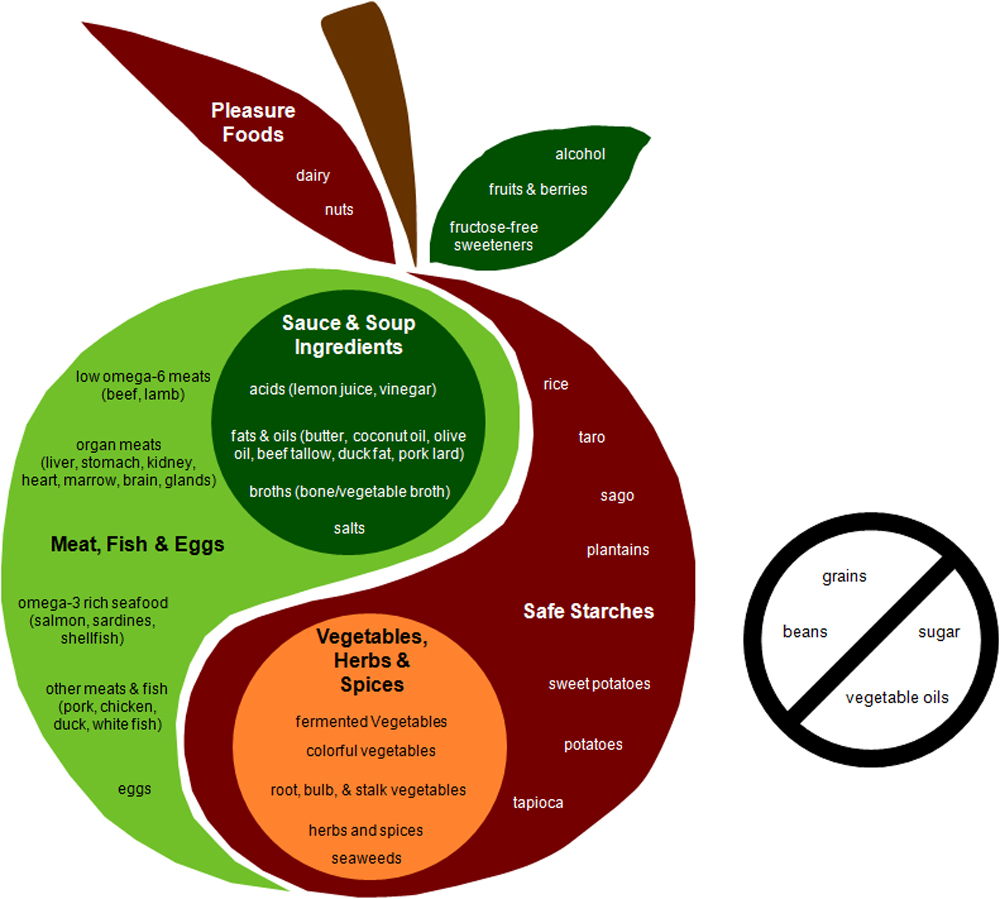
So I could see myself following one of these plans (or adopting the Weston A. Price style of eating), after I lose my weight. However, I am still 30 pounds away from goal. What to do? Low carbing has helped me to lose weight, control my blood sugars, normalize my blood pressure, and sleep better, but can it get me all the way to goal? Weight Watchers took me all the way to goal, but that is a semi-starvation plan and high in carbs, which is not good for my type II diabetes.
After a lot of thought, I will keep on with the low carb way of life (but I will double my carbs), count calories, exercise more, and perhaps other things (e.g., eliminate all artificial sweeteners, eat only whole, real foods), if necessary, until I reach my goal. However, I am very open to suggestions. When I am at goal, I will likely switch to one of the plans mentioned above for weight maintenance and general health.
Thursday, August 11, 2011
Taubes Coming Under Fire
Gary Taubes is coming under some Internet fire for comments he made at the Ancestral Health Symposium this past weekend. He basically chided the impeccably polite Stephen Guyenet of the Whole Health Source blog because Guyenet does not agree with everything Taubes says. The Internet widely views Taubes as the loser in this issue.
Guyenet politely took Taubes to task for his comments and then Paul Jaminet of the Perfect Health Diet politely defended Guyenet. Others were not so polite in their defense of Guyenet.
Now Guyenet, in his polite, scientific way, is taking on Taubes' central hypothesis that carbs (particularly refined carbs) leads to insulin spikes, which leads to fat deposition. He lays out, then refutes, Tabues' three main carbohydrate hypotheses. Just read the article. Though technical, it is worth the read.
So, if carbohydrate restriction doesn't lead to lowered insulin levels, which then causes weight loss, as Taubes suggests, how do low carb diets work? The answer is not clear, as Guyenet states, but he suggests it has something to do with greater satiety and a spontaneous reduction in calories consumed. I've come to this same conclusion and realized I needed to watch my caloric intake. I'll elaborate more in a future post.
So, what is my opinion on Taubes? I do not view him as the profiteering devil envisioned by Evelyn Kocur. I think he has made some great contributions, including demonstrating that the low fat dogma is just plain wrong. My eyes were certainly opened by reading Good Calories, Bad Calories, even if some of his ideas have been shown to be off base. And he introduced me to the low carb way of life. All I can say is, it works as advertised, at least for me. It is directly responsible for my current weight loss and the control of my type II diabetes. And for that, I am extremely grateful to Taubes. He has had a huge impact on my life, for the better.
That said, I have also learned a lot about healthy diets from folks like Jaminet, Guyenet, Chris Kresser, Kurt Harris, Sally Fallon, Weston A. Price, and others. All follow some version of a low carb lifestyle, but have discovered reasons for healthy eating other than "carbs are bad." This has directly led to the creation of this blog and has allowed me to transcend and move beyond a strict and very low carb diet.
Guyenet politely took Taubes to task for his comments and then Paul Jaminet of the Perfect Health Diet politely defended Guyenet. Others were not so polite in their defense of Guyenet.
Now Guyenet, in his polite, scientific way, is taking on Taubes' central hypothesis that carbs (particularly refined carbs) leads to insulin spikes, which leads to fat deposition. He lays out, then refutes, Tabues' three main carbohydrate hypotheses. Just read the article. Though technical, it is worth the read.
So, if carbohydrate restriction doesn't lead to lowered insulin levels, which then causes weight loss, as Taubes suggests, how do low carb diets work? The answer is not clear, as Guyenet states, but he suggests it has something to do with greater satiety and a spontaneous reduction in calories consumed. I've come to this same conclusion and realized I needed to watch my caloric intake. I'll elaborate more in a future post.
So, what is my opinion on Taubes? I do not view him as the profiteering devil envisioned by Evelyn Kocur. I think he has made some great contributions, including demonstrating that the low fat dogma is just plain wrong. My eyes were certainly opened by reading Good Calories, Bad Calories, even if some of his ideas have been shown to be off base. And he introduced me to the low carb way of life. All I can say is, it works as advertised, at least for me. It is directly responsible for my current weight loss and the control of my type II diabetes. And for that, I am extremely grateful to Taubes. He has had a huge impact on my life, for the better.
That said, I have also learned a lot about healthy diets from folks like Jaminet, Guyenet, Chris Kresser, Kurt Harris, Sally Fallon, Weston A. Price, and others. All follow some version of a low carb lifestyle, but have discovered reasons for healthy eating other than "carbs are bad." This has directly led to the creation of this blog and has allowed me to transcend and move beyond a strict and very low carb diet.
Wednesday, August 10, 2011
Where Do You Get Your Low Carb Information?
There are a lot of theories pertaining to the low carb way of eating on the Internet and in popular books. And not all of the theories are sound, or backed by hard, empirical, scientific data. So I am curious where people get their ideas from. Are you getting your ideas from a science journalist? A comedian? A romance novelist whose books have "bodice ripper" covers? Physicians (such as this one, this one, this one, and these two)? Nutrition researchers? Weight loss celebrities? Cookbook authors (such as this one, this one, and this one)?
Personally, I have learned from all of the above. However, my vote for the most hard hitting and accurate information about both the low carb way of eating and type II diabetes goes to the romance novelist with the bodice ripper covers. She has three web sites: one called Blood Sugar 101, one called What They Don't Tell You About Low Carb Diets, and a diabetes research update blog. The Blood Sugar 101 site really lays it all out and is perhaps the most important type II diabetes web site on the Internet. She explains everything associated with type II diabetes, including the low carb way of eating, medications, finger sticks, diabetes on a budget, etc. And her diabetes update blog is my go to source for up-to-date diabetes information.
Her low carb site is informed by years of experience and empirical evidence. She discusses stalls (and how to overcome them), how much weight you will lose, what happens when you fall off the low carb wagon, how to overcome "keto breath," lots of practical "in the trench" advice, etc. Ounce for ounce, it is the most meaty and useful low carb site on the Internet.
I cannot comment on her romance novels, however, as my tastes in fiction go more to science fiction and epic fantasy.
The book that influenced me the most, the one that introduced me to the low carb way of eating, is Why We Get Fat and What to Do About It by Gary Taubes. However, I am learning that Taubes is a theorist and some of his ideas, such as calories don't count and exercise doesn't help are not grounded in scientific data. This book has been enormously influential in my success, but I am starting to see the holes in some of his arguments. For that reason, it does not take second place. That honor of the second most influential source of information goes to the book The Art and Science of Low Carbohydrate Living by Jeff Volek, Ph.D., R.D., and Stephen Phinney, M.D., Ph.D. Written for other physicians, it lays out the low carb lifestyle and documents every point they make. I have reviewed the book previously on my other blog, so I won't go into great detail here. Suffice it to say that it explains the "how" of the low carb way of eating.
And a well-deserved honorable mention goes to the cookbook, Nourishing Traditions by Sally Fallon and Mary G. Enig, Ph.D. (read my review). More than a cookbook, it explains what is necessary for healthy eating and how to prepare foods to achieve optimal health. Not low carb per se, but it is extraordinarily informative. I am doing much of the cooking at home and her cookbook is my go-to source for healthy recipes.
Personally, I have learned from all of the above. However, my vote for the most hard hitting and accurate information about both the low carb way of eating and type II diabetes goes to the romance novelist with the bodice ripper covers. She has three web sites: one called Blood Sugar 101, one called What They Don't Tell You About Low Carb Diets, and a diabetes research update blog. The Blood Sugar 101 site really lays it all out and is perhaps the most important type II diabetes web site on the Internet. She explains everything associated with type II diabetes, including the low carb way of eating, medications, finger sticks, diabetes on a budget, etc. And her diabetes update blog is my go to source for up-to-date diabetes information.
Her low carb site is informed by years of experience and empirical evidence. She discusses stalls (and how to overcome them), how much weight you will lose, what happens when you fall off the low carb wagon, how to overcome "keto breath," lots of practical "in the trench" advice, etc. Ounce for ounce, it is the most meaty and useful low carb site on the Internet.
I cannot comment on her romance novels, however, as my tastes in fiction go more to science fiction and epic fantasy.
The book that influenced me the most, the one that introduced me to the low carb way of eating, is Why We Get Fat and What to Do About It by Gary Taubes. However, I am learning that Taubes is a theorist and some of his ideas, such as calories don't count and exercise doesn't help are not grounded in scientific data. This book has been enormously influential in my success, but I am starting to see the holes in some of his arguments. For that reason, it does not take second place. That honor of the second most influential source of information goes to the book The Art and Science of Low Carbohydrate Living by Jeff Volek, Ph.D., R.D., and Stephen Phinney, M.D., Ph.D. Written for other physicians, it lays out the low carb lifestyle and documents every point they make. I have reviewed the book previously on my other blog, so I won't go into great detail here. Suffice it to say that it explains the "how" of the low carb way of eating.
And a well-deserved honorable mention goes to the cookbook, Nourishing Traditions by Sally Fallon and Mary G. Enig, Ph.D. (read my review). More than a cookbook, it explains what is necessary for healthy eating and how to prepare foods to achieve optimal health. Not low carb per se, but it is extraordinarily informative. I am doing much of the cooking at home and her cookbook is my go-to source for healthy recipes.
Tuesday, August 9, 2011
Why Low Carb Works, At Least For Me
I've previously bought into a lot of the low carb hype: there is a metabolic advantage, carbs are fattening, low carb cures all, etc. But with time, wisdom arrives. The low carb way of eating seems to work for me, and, after a lot of thinking about it, here is why.
Protein and fat are very satiating and keep me full. Indeed, research shows that low carb dieters spontaneously consume fewer calories after feeling full, which leads to weight loss. This, I think, is the key element in weight loss on a carbohydrate restricted diet. But there are some other factors, too.
Protein and fat simply taste better than the low fat fare I ate on Weight Watchers. I hate skinless chicken breasts but love steak, eggs, and bacon. And vegetables. Food choices are simply easier, and for the first fifty pounds of my weight loss, I didn't have to count anything (although, I am now counting calories). I doubt I will ever go back to a Weight Watchers style, low fat diet. I genuinely like what I eat when low carbing.
That said, there seems to be a lot of misinformation about why low carb diets work. This post by Dana Carpender is a prime example. Dana, I love your cookbooks and use many of the recipes. But you are simply wrong here. She claims a five pound weight game came from eating a few too many grams of carbs over one week. In one sense, this is true and accurate. But it's not because carbs are fattening, as she implies.
When you slip up on a low carb diet, you do gain a lot of weight, almost immediately. But it's all water. When carbohydrates are stored in your body as energy in the form of glycogen, each molecule of glycogen is bonded to four molecules of water. This accounts for the first, rapid weight loss on a true, low carb diet: you deplete your glycogen stores (a 150 pound person has about a pound of glycogen stored up) and the water bonded to it. Hence, five pounds. When you replenish those glycogen stores by eating too many carbs, the water "loss" comes back. You can literally gain five pounds over night by cheating on a low carb diet.
I am quite certain this is what happened to Dana Carpender. Just get back in the saddle and try again, though you will deal with some side effects, such as hunger and higher blood sugar levels, for a couple of days. But be wise and understand it is a water gain, not a fat gain. Making you retain water is not the same thing as gaining fat, and the carbs she consumed are not fattening in the sense that she is storing extra fat. She is simply storing extra water. Think through it logically, folks: a few hundred (or even a few thousand) extra carb calories will not cause you to gain five pounds of fat.
Protein and fat are very satiating and keep me full. Indeed, research shows that low carb dieters spontaneously consume fewer calories after feeling full, which leads to weight loss. This, I think, is the key element in weight loss on a carbohydrate restricted diet. But there are some other factors, too.
Protein and fat simply taste better than the low fat fare I ate on Weight Watchers. I hate skinless chicken breasts but love steak, eggs, and bacon. And vegetables. Food choices are simply easier, and for the first fifty pounds of my weight loss, I didn't have to count anything (although, I am now counting calories). I doubt I will ever go back to a Weight Watchers style, low fat diet. I genuinely like what I eat when low carbing.
That said, there seems to be a lot of misinformation about why low carb diets work. This post by Dana Carpender is a prime example. Dana, I love your cookbooks and use many of the recipes. But you are simply wrong here. She claims a five pound weight game came from eating a few too many grams of carbs over one week. In one sense, this is true and accurate. But it's not because carbs are fattening, as she implies.
When you slip up on a low carb diet, you do gain a lot of weight, almost immediately. But it's all water. When carbohydrates are stored in your body as energy in the form of glycogen, each molecule of glycogen is bonded to four molecules of water. This accounts for the first, rapid weight loss on a true, low carb diet: you deplete your glycogen stores (a 150 pound person has about a pound of glycogen stored up) and the water bonded to it. Hence, five pounds. When you replenish those glycogen stores by eating too many carbs, the water "loss" comes back. You can literally gain five pounds over night by cheating on a low carb diet.
I am quite certain this is what happened to Dana Carpender. Just get back in the saddle and try again, though you will deal with some side effects, such as hunger and higher blood sugar levels, for a couple of days. But be wise and understand it is a water gain, not a fat gain. Making you retain water is not the same thing as gaining fat, and the carbs she consumed are not fattening in the sense that she is storing extra fat. She is simply storing extra water. Think through it logically, folks: a few hundred (or even a few thousand) extra carb calories will not cause you to gain five pounds of fat.
Subscribe to:
Posts (Atom)