This is the last post on the Low Carb Wisdom blog. But I will be continuing my blogging at a new blog, Real Food Wisdom (more on the new blog below). I am abandoning this blog as I no longer consider myself to be following a low carb way of eating. I am grateful for the introduction to the low carb lifestyle, as it opened my previously closed eyes to the realities of eating nutrient dense foods. But I no longer believe the central, low carb article of faith: the Taubesian hypothesis that carbohydrates elevate insulin levels, which in turn drives fat storage. I also reject the belief that you must only count carbs, not calories and I reject the belief that exercise does not help with weight loss. These three ideas are elaborated on at length in Gary Taubes' book, Why We Get Fat.
This means I do believe there are good carbs (e.g., potatoes, white rice) and bad carbs (e.g., refined wheat or sugar), just as there are good proteins (e.g., meat) and bad proteins (e.g., gluten) and good fats (e.g., butter or lard) and bad fats (e.g., soybean or corn oil). I am also put off by all the low carb dogma out there, where you are a "sinner" if you eat a potato or white rice. Also, there is a growing recognition that the low carb way of eating is not a magic bullet, that low carb can cause problems (and abandoning low carb may actually cure those problems), and that some carbs may actually help with weight loss.
So what do I believe? How will I be eating in the future? I now consider myself to be following a version of the Paleo diet and briefly considered creating a blog called "Paleo Wisdom" (the name is available), but I didn't want to lock myself into another diet mode (repeating the "Low Carb" mistake by linking my way of eating to a specific, named dietary approach). The version of the Paleo diet that I follow most closely is the Jaminets' Perfect Health Diet, which is controversial in the Paleo community, because it doesn't shun potatoes, rice, and dairy. But I reserve the right to change my mind in the future about what I eat, as new evidence comes along.
So what do I believe? And how will it affect my future diet?
I believe that natural, real, whole foods are best, foods with very little or no processing. This means I am open to some non-Paleo belief systems, such as the Weston A. Price view of nutrition. It also means that things like potatoes and bananas are fine to eat, in moderation, and perhaps even correctly prepared, ancestral wheat.
I believe that eating animal products is essential to good health.
I believe that correctly rendered lard, butter, egg yolks, meat, coconut and olive oils, tree nuts and other high fat items are healthy for you and won't give you a heart attack. I am grateful to Good Calories, Bad Calories by Gary Taubes for opening my eyes on this point.
I believe that calories count, that this is the biggest determinant of weight loss and maintenance. I also believe that calorie restriction is necessary for maintaining appropriate blood glucose levels. It is not all about eliminating carbs, it is also about limiting calories. Adding in potatoes and rice, while watching calories, actually helped me stabilize my blood glucose levels.
I believe in eating vegetables. Lots of vegetables. And some fruit.
I now believe that food reward and palatability are crucial concepts to understand in losing and maintaining weight. I believe that simple foods are best, for most occasions. Thank you, Stephan Guyenet.
I believe in exercise. Both resistance training and cardio vascular. Just not to excess.
I believe that eating nutrient dense, whole, real foods is a high fat, moderate protein, and low carb approach to eating. Therefore, it is not necessary to add fat just to be more healthy. It is already high fat.
I believe in (this may surprise you) the Weight Watchers approach to losing weight. Not their low fat mantra nor their fat phobia, but their psychological perspective on weight loss, the weekly accountability of weighing in and the community support one gets from interacting with others on a similar weight loss journey. One of my most gratifying experiences in life was when I was a leader at Weight Watchers. I have written about this before and I am now actively considering re-joining Weight Watchers, but on my own terms. Calories count, but counting calories is a bummer. Counting points is easier. I can eat Paleo using their point system to track calories and I will lose weight. Plus I will gain the support of the people in the weekly meetings and perhaps influence some of their attitudes about eating real food.
So if you have enjoyed what I have written on Low Carb Wisdom, consider following me as I transition to Real Food Wisdom. The first post will be up shortly, probably tomorrow.
Showing posts with label Guyenet. Show all posts
Showing posts with label Guyenet. Show all posts
Saturday, March 17, 2012

Thursday, January 12, 2012
Eating Safe Starches Lowers my Blood Glucose Levels
Recently, I have been aggressively monitoring my blood glucose levels and I have noticed a very interesting pattern. On days when I do not eat safe starches, my fasting blood glucose level the next morning is approximately 105. However, when I do eat safe starches (usually a sweet potato, regular potato, or white rice), the next morning my fasting blood glucose level is approximately 95.
So I have been testing this idea by purposefully not eating any safe starches one day and checking my fasting blood glucose level the next morning. Like clockwork, my blood glucose levels are higher the next morning. When I eat safe starches, the fasting reading the next day goes down to 95. I am getting a 10-point drop the next day by eating safe starches. This is a very consistent finding.
Even more curious, on days when I forego the safe starches, I am actually consuming fewer calories than the days when I eat them. My menus have been very consistent across all of these tests (I am trying to eat simple and dull meals, as suggested by Jenny Ruhl and Stephan Guyenet). So if I am eating less food, why are the fasting readings always higher? For purposes of full disclosure, my one hour readings are almost always below 125 and two hour readings are almost always below 100. Not bad for a type II diabetic. The Perfect Health Diet has effectively controlled my disease.
So is the consumption of safe starches actually contributing to lowering my blood glucose levels? That is what it looks like to me.
See my previous entries on safe starches here, here, and here.
So I have been testing this idea by purposefully not eating any safe starches one day and checking my fasting blood glucose level the next morning. Like clockwork, my blood glucose levels are higher the next morning. When I eat safe starches, the fasting reading the next day goes down to 95. I am getting a 10-point drop the next day by eating safe starches. This is a very consistent finding.
Even more curious, on days when I forego the safe starches, I am actually consuming fewer calories than the days when I eat them. My menus have been very consistent across all of these tests (I am trying to eat simple and dull meals, as suggested by Jenny Ruhl and Stephan Guyenet). So if I am eating less food, why are the fasting readings always higher? For purposes of full disclosure, my one hour readings are almost always below 125 and two hour readings are almost always below 100. Not bad for a type II diabetic. The Perfect Health Diet has effectively controlled my disease.
So is the consumption of safe starches actually contributing to lowering my blood glucose levels? That is what it looks like to me.
See my previous entries on safe starches here, here, and here.
Tuesday, September 27, 2011
Why We Get Fat, According to...
Gary Taubes blames carbs, especially the refined carbs like wheat and sugar.
Laura Dolson is generally with Taubes on the refined carbs, but she also blames marketing.
<Rant>
As a marketing professor, I find straw men arguments like this patently ridiculous. Marketing is not all powerful; if it were, I would have created a junk product and marketed it to all of you idiots out there, who would have bought it. You wouldn't have a choice; marketing would have forced you to buy it, and I could retire in style to the French Riviera. Unfortunately, life isn't like that. Consumers have brains and can choose to not purchase marketed products. Up to 95% of new products fail, despite massive amounts of marketing. The influence of the home can swamp any marketing campaign. Massive amounts of food industry marketing do not work on me, for example, or the example I set in my family. I have a brain and I choose differently.
Also, does marketing/advertising create food attitudes, or merely reflect already existing attitudes in people? Any competent social scientist will tell you it is very hard to change behavior. While I think marketing can help to create attitudes, it mostly reflects what already exists. Take smoking, for example. Reasons people smoke include parental example/rebellion against parents; peer pressure; stress and anxiety reductions; desire to lose weight, etc. Marketing, though often blamed for smoking (Exhibit A: Joe Camel), is not even mentioned as a factor (I would argue that marketing only informs brand choice, not the decision to smoke). Get real, folks. Marketing is just not as powerful as you would like to believe. It may be a convenient whipping boy, but your belief in the absolute power of marketing is a fantasy.
</Rant>
Kurt Harris blames the Neolithic Agents of Disease, including fructose, wheat, and seed oils.
Stephan Guyenet blames highly palatable food choices for weight gain.
Paul Jaminet blames malnutrition, dietary toxins, and infections for obesity.
Chris Kresser says there is no single cause of or treatment for obesity. Later, he says that modern lifestyle + genetic predisposition = obesity.
What do I believe? I used to believe Gary Taubes, because the solution he proposed worked for me, to a point. Harris, Jaminet, and Kresser are all singing variations of the same tune, so I suppose I am in their camp now. I am following the Perfect Health Diet, though I am stalled at the moment. They seem the most reasonable, the most scientifically based, even though I have criticized science as a justifying principle for belief. But I guess I have to hang my hat somewhere.
Laura Dolson is generally with Taubes on the refined carbs, but she also blames marketing.
<Rant>
As a marketing professor, I find straw men arguments like this patently ridiculous. Marketing is not all powerful; if it were, I would have created a junk product and marketed it to all of you idiots out there, who would have bought it. You wouldn't have a choice; marketing would have forced you to buy it, and I could retire in style to the French Riviera. Unfortunately, life isn't like that. Consumers have brains and can choose to not purchase marketed products. Up to 95% of new products fail, despite massive amounts of marketing. The influence of the home can swamp any marketing campaign. Massive amounts of food industry marketing do not work on me, for example, or the example I set in my family. I have a brain and I choose differently.
Also, does marketing/advertising create food attitudes, or merely reflect already existing attitudes in people? Any competent social scientist will tell you it is very hard to change behavior. While I think marketing can help to create attitudes, it mostly reflects what already exists. Take smoking, for example. Reasons people smoke include parental example/rebellion against parents; peer pressure; stress and anxiety reductions; desire to lose weight, etc. Marketing, though often blamed for smoking (Exhibit A: Joe Camel), is not even mentioned as a factor (I would argue that marketing only informs brand choice, not the decision to smoke). Get real, folks. Marketing is just not as powerful as you would like to believe. It may be a convenient whipping boy, but your belief in the absolute power of marketing is a fantasy.
</Rant>
Kurt Harris blames the Neolithic Agents of Disease, including fructose, wheat, and seed oils.
Stephan Guyenet blames highly palatable food choices for weight gain.
Paul Jaminet blames malnutrition, dietary toxins, and infections for obesity.
Chris Kresser says there is no single cause of or treatment for obesity. Later, he says that modern lifestyle + genetic predisposition = obesity.
What do I believe? I used to believe Gary Taubes, because the solution he proposed worked for me, to a point. Harris, Jaminet, and Kresser are all singing variations of the same tune, so I suppose I am in their camp now. I am following the Perfect Health Diet, though I am stalled at the moment. They seem the most reasonable, the most scientifically based, even though I have criticized science as a justifying principle for belief. But I guess I have to hang my hat somewhere.
Sunday, August 14, 2011
Thinking Through Diet Options
The recent Internet firestorm involving Gary Taubes and Stephan Guyenet has left me with a lot of questions.
As a weight loss method, low carb works--to a point. I have lost 55 pounds in six months, but I am still 30 pounds from my goal weight and I am stalled. There is a lot of chatter on the Internet about stalls: they happen after you lose between 17 and 20% of your body weight. I have lost about 18% of my body weight fairly effortlessly without really counting anything on a low carb diet, then I stalled, and am now counting calories to break through the stall. So far, I am very slowly creeping downward.
Is Taubes wrong? Is the problem carbohydrates, or something else? Clearly, what he advocates (reducing carbs) works, at least to a point, and at least for me. But why does it work? In substantially reducing carbs, I have cut out all forms of wheat and most forms of sugar, two carbs widely believed to be problematic. Heck, even the low fat, high carb dieters come out against sugar. But is Taubes condemning all carbs, when only some of them are bad? Isn't this what happened with fat? Ancel Keys waged war against saturated fat and now America is lipophobic (afraid of fat). Taubes describes the complete history of the Keys and the lipid hypothesis ("saturated fats cause heart disease") in Good Calories Bad Calories.
Is Gary Taubes doing the same thing to carbohydrates? One person described Taubes as the "Ancel Keys of carbohydrates." Ouch, that's gotta hurt. But Taubes is relentlessly promoting the "carbs are bad, carbs --> insulin --> fat accumulation" hypothesis. So the comment may hurt because there is more than a ring of truth to it. Is Taubes pushing a solution that is potentially as bad, in its own way, as Keys' agenda was? America is now lipophobic; will Taubes cause us to become carbophobic as well?
Many in the low carb blogosphere point out that carbs are not bad across the board. Certain foods, which happen to be carbohydrates, are bad (e.g., high fructose corn syrup, sugar, flour and wheat products, etc.; see Kurt Harris, M.D. and Paul Jaminet, Ph.D. [see this page, too] ). But vegetable oils, such as corn, soy, canola, etc., are also bad, according to these two sites, and they are fats, not carbohydrates. Kurt Harris tells us to ignore macro nutrients (fats, carbs, protein) altogether and instead avoid the NADs, or "neolithic agents of disease." In other words, fructose, wheat, and vegetable oils. Both Harris and Jaminet are okay with eating non-problematic carbs such as white rice, yams, and potatoes. However, neither Harris nor Jaminet are diabetic and their plans for eating are not necessarily approaches to weight loss.
So I could see myself following one of these plans (or adopting the Weston A. Price style of eating), after I lose my weight. However, I am still 30 pounds away from goal. What to do? Low carbing has helped me to lose weight, control my blood sugars, normalize my blood pressure, and sleep better, but can it get me all the way to goal? Weight Watchers took me all the way to goal, but that is a semi-starvation plan and high in carbs, which is not good for my type II diabetes.
After a lot of thought, I will keep on with the low carb way of life (but I will double my carbs), count calories, exercise more, and perhaps other things (e.g., eliminate all artificial sweeteners, eat only whole, real foods), if necessary, until I reach my goal. However, I am very open to suggestions. When I am at goal, I will likely switch to one of the plans mentioned above for weight maintenance and general health.
As a weight loss method, low carb works--to a point. I have lost 55 pounds in six months, but I am still 30 pounds from my goal weight and I am stalled. There is a lot of chatter on the Internet about stalls: they happen after you lose between 17 and 20% of your body weight. I have lost about 18% of my body weight fairly effortlessly without really counting anything on a low carb diet, then I stalled, and am now counting calories to break through the stall. So far, I am very slowly creeping downward.
Is Taubes wrong? Is the problem carbohydrates, or something else? Clearly, what he advocates (reducing carbs) works, at least to a point, and at least for me. But why does it work? In substantially reducing carbs, I have cut out all forms of wheat and most forms of sugar, two carbs widely believed to be problematic. Heck, even the low fat, high carb dieters come out against sugar. But is Taubes condemning all carbs, when only some of them are bad? Isn't this what happened with fat? Ancel Keys waged war against saturated fat and now America is lipophobic (afraid of fat). Taubes describes the complete history of the Keys and the lipid hypothesis ("saturated fats cause heart disease") in Good Calories Bad Calories.
Is Gary Taubes doing the same thing to carbohydrates? One person described Taubes as the "Ancel Keys of carbohydrates." Ouch, that's gotta hurt. But Taubes is relentlessly promoting the "carbs are bad, carbs --> insulin --> fat accumulation" hypothesis. So the comment may hurt because there is more than a ring of truth to it. Is Taubes pushing a solution that is potentially as bad, in its own way, as Keys' agenda was? America is now lipophobic; will Taubes cause us to become carbophobic as well?
Many in the low carb blogosphere point out that carbs are not bad across the board. Certain foods, which happen to be carbohydrates, are bad (e.g., high fructose corn syrup, sugar, flour and wheat products, etc.; see Kurt Harris, M.D. and Paul Jaminet, Ph.D. [see this page, too] ). But vegetable oils, such as corn, soy, canola, etc., are also bad, according to these two sites, and they are fats, not carbohydrates. Kurt Harris tells us to ignore macro nutrients (fats, carbs, protein) altogether and instead avoid the NADs, or "neolithic agents of disease." In other words, fructose, wheat, and vegetable oils. Both Harris and Jaminet are okay with eating non-problematic carbs such as white rice, yams, and potatoes. However, neither Harris nor Jaminet are diabetic and their plans for eating are not necessarily approaches to weight loss.
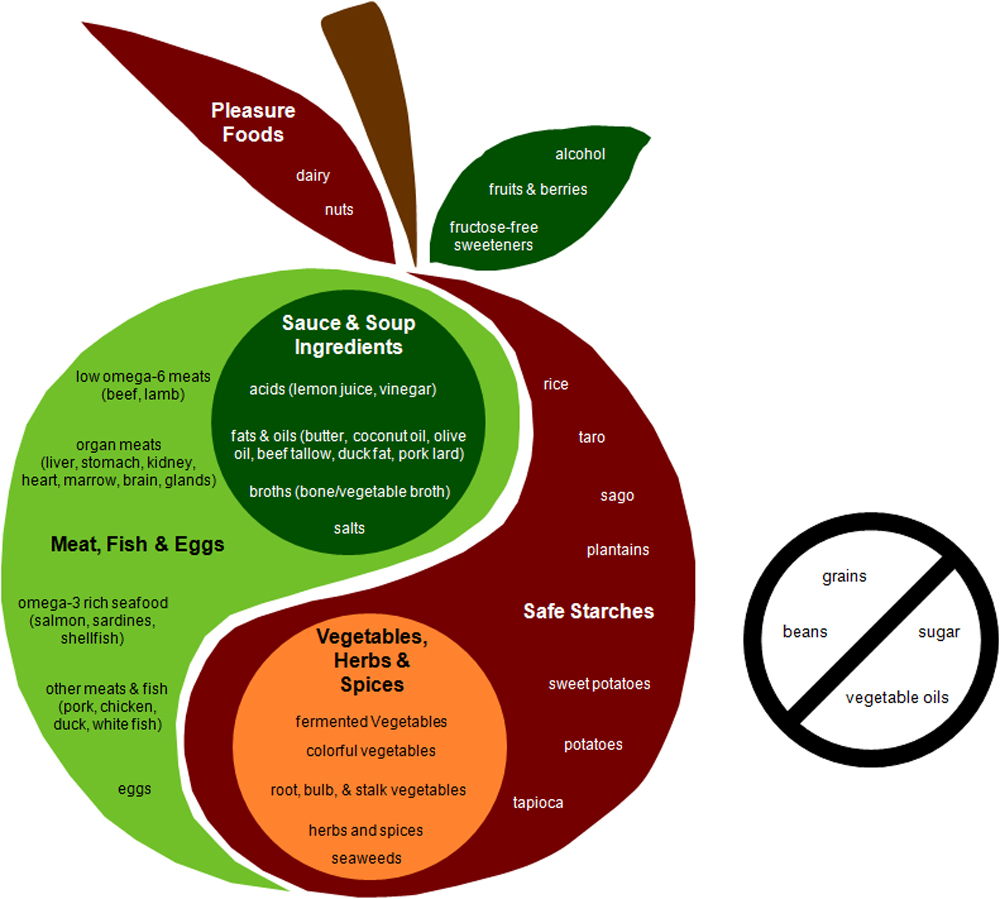
So I could see myself following one of these plans (or adopting the Weston A. Price style of eating), after I lose my weight. However, I am still 30 pounds away from goal. What to do? Low carbing has helped me to lose weight, control my blood sugars, normalize my blood pressure, and sleep better, but can it get me all the way to goal? Weight Watchers took me all the way to goal, but that is a semi-starvation plan and high in carbs, which is not good for my type II diabetes.
After a lot of thought, I will keep on with the low carb way of life (but I will double my carbs), count calories, exercise more, and perhaps other things (e.g., eliminate all artificial sweeteners, eat only whole, real foods), if necessary, until I reach my goal. However, I am very open to suggestions. When I am at goal, I will likely switch to one of the plans mentioned above for weight maintenance and general health.
Thursday, August 11, 2011
Taubes Coming Under Fire
Gary Taubes is coming under some Internet fire for comments he made at the Ancestral Health Symposium this past weekend. He basically chided the impeccably polite Stephen Guyenet of the Whole Health Source blog because Guyenet does not agree with everything Taubes says. The Internet widely views Taubes as the loser in this issue.
Guyenet politely took Taubes to task for his comments and then Paul Jaminet of the Perfect Health Diet politely defended Guyenet. Others were not so polite in their defense of Guyenet.
Now Guyenet, in his polite, scientific way, is taking on Taubes' central hypothesis that carbs (particularly refined carbs) leads to insulin spikes, which leads to fat deposition. He lays out, then refutes, Tabues' three main carbohydrate hypotheses. Just read the article. Though technical, it is worth the read.
So, if carbohydrate restriction doesn't lead to lowered insulin levels, which then causes weight loss, as Taubes suggests, how do low carb diets work? The answer is not clear, as Guyenet states, but he suggests it has something to do with greater satiety and a spontaneous reduction in calories consumed. I've come to this same conclusion and realized I needed to watch my caloric intake. I'll elaborate more in a future post.
So, what is my opinion on Taubes? I do not view him as the profiteering devil envisioned by Evelyn Kocur. I think he has made some great contributions, including demonstrating that the low fat dogma is just plain wrong. My eyes were certainly opened by reading Good Calories, Bad Calories, even if some of his ideas have been shown to be off base. And he introduced me to the low carb way of life. All I can say is, it works as advertised, at least for me. It is directly responsible for my current weight loss and the control of my type II diabetes. And for that, I am extremely grateful to Taubes. He has had a huge impact on my life, for the better.
That said, I have also learned a lot about healthy diets from folks like Jaminet, Guyenet, Chris Kresser, Kurt Harris, Sally Fallon, Weston A. Price, and others. All follow some version of a low carb lifestyle, but have discovered reasons for healthy eating other than "carbs are bad." This has directly led to the creation of this blog and has allowed me to transcend and move beyond a strict and very low carb diet.
Guyenet politely took Taubes to task for his comments and then Paul Jaminet of the Perfect Health Diet politely defended Guyenet. Others were not so polite in their defense of Guyenet.
Now Guyenet, in his polite, scientific way, is taking on Taubes' central hypothesis that carbs (particularly refined carbs) leads to insulin spikes, which leads to fat deposition. He lays out, then refutes, Tabues' three main carbohydrate hypotheses. Just read the article. Though technical, it is worth the read.
So, if carbohydrate restriction doesn't lead to lowered insulin levels, which then causes weight loss, as Taubes suggests, how do low carb diets work? The answer is not clear, as Guyenet states, but he suggests it has something to do with greater satiety and a spontaneous reduction in calories consumed. I've come to this same conclusion and realized I needed to watch my caloric intake. I'll elaborate more in a future post.
So, what is my opinion on Taubes? I do not view him as the profiteering devil envisioned by Evelyn Kocur. I think he has made some great contributions, including demonstrating that the low fat dogma is just plain wrong. My eyes were certainly opened by reading Good Calories, Bad Calories, even if some of his ideas have been shown to be off base. And he introduced me to the low carb way of life. All I can say is, it works as advertised, at least for me. It is directly responsible for my current weight loss and the control of my type II diabetes. And for that, I am extremely grateful to Taubes. He has had a huge impact on my life, for the better.
That said, I have also learned a lot about healthy diets from folks like Jaminet, Guyenet, Chris Kresser, Kurt Harris, Sally Fallon, Weston A. Price, and others. All follow some version of a low carb lifestyle, but have discovered reasons for healthy eating other than "carbs are bad." This has directly led to the creation of this blog and has allowed me to transcend and move beyond a strict and very low carb diet.
Subscribe to:
Posts (Atom)